Event submissions
Published
This submission belongs to the session S1. Multiple Myeloma of the event The 1st International Online Conference on Hematology
Published date
23 Oct, 2026
Academic Editor
 Claudio Cerchione
Citation
Nadjia BENKHIRA, ramdane ALLALI, Abdelali BELHACHEM, Nadia GUERD, Naima MESLI, Prognostic Impact of Renal Recovery in Multiple Myeloma Patients with Baseline Renal Impairment: A Multicenter Algerian Prospective Study, in Proceedings of The 1st International Online Conference on Hematology, 28 October–30 October 2026, MDPI: Basel, Switzerland
Share
Email
Facebook
Twitter
LinkedIn
Prognostic Impact of Renal Recovery in Multiple Myeloma Patients with Baseline Renal Impairment: A Multicenter Algerian Prospective Study

Nadjia BENKHIRA 1
ramdane ALLALI 1
Abdelali BELHACHEM 1
Nadia GUERD 2
Naima MESLI 2
1. Medical faculty, Tahri Mohamed University Bechar, Béchar, Algeria
2. Medical Department, Faculty of Medicine, Abou Bekr Belkaid University, Tlemcen, Algeria
Abstract
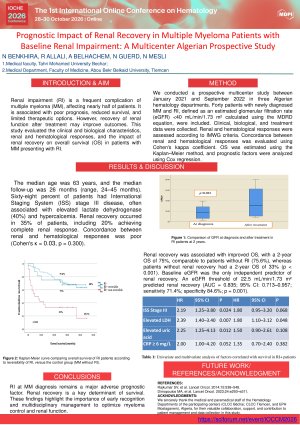
Background: Renal impairment (RI) is a frequent complication of multiple myeloma (MM), affecting nearly half of patients. It is associated with poor prognosis, reduced survival, and limited therapeutic options. However, recovery of renal function after treatment may improve outcomes. This study evaluated the clinical and biological characteristics, renal and hematological responses, and the impact of renal recovery on overall survival (OS) in patients with MM presenting with RI.
Methods: We conducted a prospective multicenter study between January 2021 and September 2022 in three Algerian hematology departments. Forty patients with newly diagnosed MM and RI, defined as an estimated glomerular filtration rate (eGFR) <40 mL/min/1.73 m² calculated using the MDRD equation, were included. Clinical, biological, and treatment data were collected. Renal and hematological responses were assessed according to IMWG criteria. Concordance between renal and hematological responses was evaluated using Cohen's kappa coefficient. OS was estimated using the Kaplan–Meier method, and prognostic factors were analyzed using Cox regression.
Results: The median age was 63 years, and the median follow-up was 26 months (range, 24–45 months). Sixty-eight percent of patients had International Staging System (ISS) stage III disease, often associated with elevated lactate dehydrogenase (40%) and hypercalcemia. Renal recovery occurred in 35% of patients, including 20% achieving complete renal response. Concordance between renal and hematological responses was poor (Cohen's κ = 0.03, p = 0.300). Renal recovery was associated with improved OS, with a 2-year OS of 75%, comparable to patients without RI (75.6%), whereas patients without renal recovery had a 2-year OS of 33% (p < 0.001). Baseline eGFR was the only independent predictor of renal recovery. An eGFR threshold of 22.5 mL/min/1.73 m² predicted renal recovery (AUC = 0.835; 95% CI: 0.713–0.957; sensitivity 71.4%; specificity 84.6%; p = 0.001).
Conclusion: RI at MM diagnosis remains a major adverse prognostic factor. Renal recovery is a key determinant of survival. These findings highlight the importance of early recognition and multidisciplinary management to optimize myeloma control and renal function.
Keywords
Multiple myeloma
renal impairment
renal recovery
overall survival
prognosis.
Poster
Prognostic Impact of Renal Recovery in Multiple Myeloma Patients with Baseline Renal Impairment.pdf
From Genetic Insights to Public Health Action: β-Thalassemia Carrier Screening Among Youths in Delhi NCR
Redefining the Treatment Continuum: A Toxicity- and Response-Adapted Framework for Sequencing Autologous CAR-T, Allogeneic Stem Cell Transplantation, and Bispecific T-Cell Engagers in Relapsed/Refractory Hematologic Malignancies