Event submissions
Published
This submission belongs to the session D. Food Microbiology & Biotechnologies of the event The 7th International Electronic Conference on Foods
Published date
23 Oct, 2026
Academic Editor
 Efstathios Giaouris
Citation
Elena Lekakou, Heat-stable antifungal activity of a wild Bacillus sp. against food-spoilage moulds: a promising approach for clean-label food preservation, in Proceedings of The 7th International Electronic Conference on Foods, 28 October–30 October 2026, MDPI: Basel, Switzerland
Share
Email
Facebook
Twitter
LinkedIn
Heat-stable antifungal activity of a wild Bacillus sp. against food-spoilage moulds: a promising approach for clean-label food preservation

Elena Lekakou 1
1. Department of Biotechnology, Agricultural University of Athens, Athens 11855, Greece
Abstract
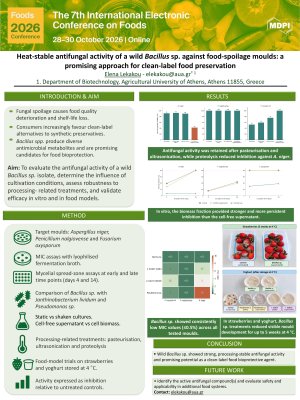
Introduction: Fungal spoilage causes food quality deterioration and shelf-life loss, while consumers increasingly favour clean-label alternatives to synthetic preservatives. Bacillus species produce diverse antimicrobial metabolites and may represent promising candidates for food bioprotection. This study evaluated the antifungal activity of a wild Bacillus sp. isolate against common food-spoilage moulds and examined how cultivation conditions, cellular fraction and processing-related treatments influence this activity.
Methods: Bacillus sp. was tested against Aspergillus niger, Penicillium nalgiovense and Fusarium oxysporum using mycelial spread-zone assays on PDA at early and late incubation time points, MIC assays with lyophilised fermentation broth, and food-model trials on refrigerated strawberries and yoghurt. Bacillus sp. MIC values were compared with those of Janthinobacterium lividum and Pseudomonas sp. Static versus shaken cultivation and cell-free supernatant versus cell biomass were compared. The active biomass was then subjected to pasteurisation, autoclaving, ultrasonication and enzymatic hydrolysis with pepsin and trypsin. Activity was expressed as inhibition relative to untreated controls.
Results: Bacillus sp. inhibited all tested moulds and exhibited the lowest MIC values among the three isolates (≤0.5–1%). In refrigerated strawberries and yoghurt, it prevented visible mould development for up to five weeks. Activity was primarily associated with the cell biomass rather than the supernatant and was largely retained after pasteurisation, autoclaving and ultrasonication. In contrast, proteolytic treatment reduced activity, suggesting that proteinaceous compounds may contribute to the antifungal effect. Static cultivation generally produced stronger inhibition than shaken cultivation.
Conclusions: This wild Bacillus sp. combined broad-spectrum antifungal activity with food-model efficacy and resistance to processing-related treatments, supporting its potential as a clean-label bioprotective candidate against food-spoilage moulds. Further studies should identify the active compound(s) and evaluate their safety and applicability in food systems.
Keywords
Bacillus sp.
antifungal activity
food biopreservation
food spoilage fungi
clean-label preservation
heat-stable antimicrobial compounds
minimum inhibitory concentration (MIC)
Poster
Foods poster_Lekakou_Elena.pdf
Production and Evaluation of a Novel GABA-Producing Plant Yogurt and its Functional Benefits
Development of type II sourdoughs using Lactiplantibacillus plantarum CIDCA 8327 in gluten-free matrices