Event submissions
Published
This submission belongs to the session D. Food Microbiology & Biotechnologies of the event The 7th International Electronic Conference on Foods
Published date
23 Oct, 2026
Academic Editor
 Efstathios Giaouris
Citation
Camila Vitale, Irene Albertina Rubel, Marianela Capitani, Carolina Iraporda, Development of type II sourdoughs using Lactiplantibacillus plantarum CIDCA 8327 in gluten-free matrices, in Proceedings of The 7th International Electronic Conference on Foods, 28 October–30 October 2026, MDPI: Basel, Switzerland
Share
Email
Facebook
Twitter
LinkedIn
Development of type II sourdoughs using Lactiplantibacillus plantarum CIDCA 8327 in gluten-free matrices

Camila Vitale 1
Irene Albertina Rubel 1
Marianela Capitani 1,2
Carolina Iraporda 1,2
1. Department of Chemical Engineering and Food Technology (TECSE), Faculty of Engineering, National University of the Center of Buenos Aires Province, Olavarría 7400, Buenos Aires, Argentina
2. Center for Research in Physics and Engineering of Central Buenos Aires Province (CIFICEN, CONICET-CIC-UNCPBA), Olavarría 7400, Buenos Aires, Argentina
Abstract
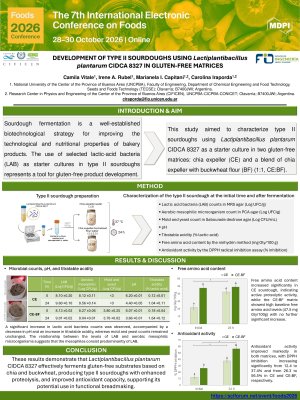
Sourdough fermentation is a well-established biotechnological strategy for improving the technological and nutritional properties of bakery products. The use of selected lactic-acid bacteria (LAB) as starter cultures in type II sourdoughs represents a tool for gluten-free product development. This study aimed to characterize type II sourdoughs using Lactiplantibacillus plantarum CIDCA8327 as a starter culture in two gluten-free matrices: chia expeller (CE) and a blend of chia expeller with buckwheat flour (1:1, CE:BF), with dough yields of 400 and 300, respectively. Bacterial suspensions were prepared from MRS cultures (37 °C, 24 h), centrifuged, and resuspended to achieve an inoculum of 7 log CFU/g. Fermentation was conducted at 30 °C for 24 h. Sourdoughs were characterized for LAB counts (MRS agar), yeast and mold counts (Sabourade agar), pH, titratable acidity (% lactic acid), free amino acid content (ninhydrin method), and antioxidant activity (DPPH radical inhibition assay). After fermentation, LAB counts increased significantly, reaching 9.60±0.06 log CFU/g in CE and 9.01±0.02 log CFU/g in CE:BF, while mold and yeast found were <4 log CFU/g in both samples. The pH decreased from 6.1 to 4.40 in CE and from 6.2 to 3.66 in CE:BF, while titratable acidity increased to 1.04 and 1.84% lactic acid in CE and CE:BF, respectively. Free amino acid content increased significantly in CE (from 21.8 to 42.4 mg glycine/100g), indicating active proteolytic activity, while the CE:BF matrix showed high baseline amino acid levels (47.5 mg/100g) with no significant further increase post-fermentation. Antioxidant activity improved markedly in both matrices, with DPPH inhibition increasing from 12.4 to 37.4% and from 26.3 to 56.5% in CE and CE:BF, respectively. These results demonstrate that L. plantarum CIDCA8327 effectively ferments gluten-free substrates based on chia and buckwheat, producing type II sourdoughs with enhanced proteolysis, and improved antioxidant capacity, supporting its potential for their use in functional breadmaking.
Keywords
Sourdough
lactic acid bacteria
starter microorganisms
chia expeller
bockwheat flour
Poster
Foods Conference 2026 - Poster Vitale y cols..pdf
Heat-stable antifungal activity of a wild Bacillus sp. against food-spoilage moulds: a promising approach for clean-label food preservation
MODELLING THE COMBINED EFFECTS OF pH AND TEMPERATURE ON BIOFILM FORMATION DYNAMICS OF A MULTIDRUG RESISTANCE STRAIN OF STAPHYLOCOCCUS AUREUS