Event submissions
Published
This submission belongs to the session S7. Stem Cell Transplantation and New Cellular Therapies of the event The 1st International Online Conference on Hematology
Published date
23 Oct, 2026
Academic Editor
 Aurelio Maggio
Citation
Luis Ramalhete, Paula Almeida, Olga Abade, Sara Calao, Raquel Ferreira, Eduardo Espada, Mapping Donor Access for HSCT: Related, Haploidentical, and Unrelated Options in a Portuguese HLA Cohort, in Proceedings of The 1st International Online Conference on Hematology, 28 October–30 October 2026, MDPI: Basel, Switzerland
Share
Email
Facebook
Twitter
LinkedIn
Mapping Donor Access for HSCT: Related, Haploidentical, and Unrelated Options in a Portuguese HLA Cohort

Luis Ramalhete 1,2,3
Paula Almeida 1
Olga Abade 1
Sara Calao 1
Raquel Ferreira 1
Eduardo Espada 1,4,5
1. Transplantation Functional Area, Lisbon Blood and Transplantation Centre, Portuguese Institute of Blood and Transplantation, Lisbon, 1769-001, Portugal
2. iNOVA4Health—Advancing Precision Medicine, Renal Diseases Research Group, NOVA Medical School, Universidade NOVA de Lisboa, Lisbon, 1169-056, Portugal
3. N/A, LBS - Lisbon Business & Government School, Lisbon, 1200-427, Portugal
4. Department of Hematology, ULS Santa Maria, Hospital de Santa Maria, Lisbon, 1649-028, Portugal
5. Faculty of Medicine, University of Lisbon, Lisbon, 1649-028, Portugal
Abstract
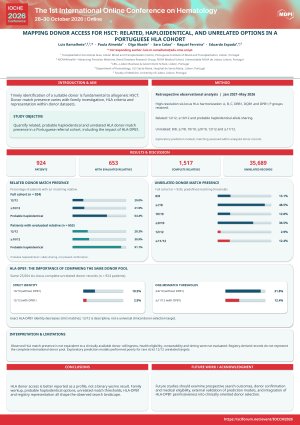
Introduction: Timely donor identification remains a major step in allogeneic hematopoietic stem cell transplantation (HSCT). However, donor availability depends on the donor source, family workup, HLA matching threshold, and population-background representation in donor registries. We assessed donor access in a Portuguese HLA referral cohort using related and unrelated donor data.
Methods: We performed a retrospective observational analysis of fully anonymized patient, relative, and unrelated donor datasets from January 2021 to May 2026. HLA-A, HLA-B, HLA-C, HLA-DRB1, HLA-DQB1, and HLA-DPB1 were harmonized at high-resolution two-field level. The fixed cohort included 924 patients with complete six-locus data. Related donor availability was assessed at 12/12, ≥10/12, and probable haploidentical levels. Unrelated donor availability was assessed at 8/8, ≥7/8, 10/10, ≥9/10, 12/12, and ≥11/12 thresholds. HLA-DPB1 impact and exploratory prediction models were also evaluated.
Results: In the full cohort, 185 patients (20.0%) had a 12/12 related donor, 202 (21.9%) had a ≥10/12 related donor, and 595 (64.4%) had a probable haploidentical related donor. Among 653 patients with at least one complete evaluated relative, these values increased to 28.3%, 30.9%, and 91.1%, respectively. Unrelated donor availability was 13.1% for 8/8, 48.5% for ≥7/8, 12.8% for 10/10, 36.5% for ≥9/10, 2.9% for 12/12, and 12.4% for ≥11/12. HLA-DPB1 inclusion reduced strict unrelated matching more markedly than related matching. Prediction models showed moderate discrimination for several donor-availability targets, but weak performance for rare strict 12/12 unrelated availability.
Conclusions: Donor availability should be reported as a donor-access profile rather than as a binary result. Family workup, probable haploidentical options, unrelated donor thresholds, HLA-DPB1, and registry representation all influence realistic HSCT donor access.
Keywords
HSCT
HLA matching
donor availability
haploidentical donor
unrelated donor
HLA-DPB1
donor registry
Portugal
Poster
IOHCE2026.pdf
Redefining the Treatment Continuum: A Toxicity- and Response-Adapted Framework for Sequencing Autologous CAR-T, Allogeneic Stem Cell Transplantation, and Bispecific T-Cell Engagers in Relapsed/Refractory Hematologic Malignancies
Diverse Hematologic and Molecular Characteristics of Hemoglobin O-Arab in the Moroccan Population: Experience of Mohammed VI National Laboratory of Medical Analysis.