Event submissions
Published
This submission belongs to the session D. Food Microbiology & Biotechnologies of the event The 7th International Electronic Conference on Foods
Published date
23 Oct, 2026
Academic Editor
 Efstathios Giaouris
Citation
Yousra Meriem Berrached, Ana Sofia Faria, Vasco Cadavez, Ursula Gonzales-Barron, MODELLING THE COMBINED EFFECTS OF pH AND TEMPERATURE ON BIOFILM FORMATION DYNAMICS OF A MULTIDRUG RESISTANCE STRAIN OF STAPHYLOCOCCUS AUREUS, in Proceedings of The 7th International Electronic Conference on Foods, 28 October–30 October 2026, MDPI: Basel, Switzerland
Share
Email
Facebook
Twitter
LinkedIn
MODELLING THE COMBINED EFFECTS OF pH AND TEMPERATURE ON BIOFILM FORMATION DYNAMICS OF A MULTIDRUG RESISTANCE STRAIN OF STAPHYLOCOCCUS AUREUS

Yousra Meriem Berrached 1

Ana Sofia Faria 2
Vasco Cadavez 1

Ursula Gonzales-Barron 1
1. Associate Laboratory for Sustainability and Technology in Mountains Regions (SusTEC), Polytechnic Institute of Braganza, Campus de Santa Apolonia 5300-253, Braganza, Portugal
2. Universidade de Vigo, Nutrition and Bromatology Group, Department of Analytical Chemistry and Food Science, Instituto de Agroecoloxía e Alimentación (IAA)—CITEXVI, 36310 Vigo, Spain
Abstract
Staphylococcus aureus is a resilient pathogen capable of forming biofilms that promote survival in food processing environments. Understanding how environmental factors such as pH and temperature interact over time is essential for developing effective control strategies.
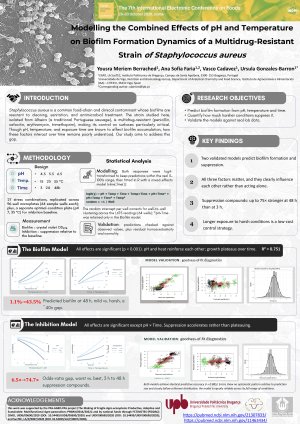
This study evaluated the biofilm-forming capacity of a multidrug-resistant (penicillin, cefoxitin, erythromycin, trimethoprim) S. aureus strain isolated from Portuguese traditional sausages, grown in glucose tryptic soy broth under optimal and suboptimal conditions. Under a full factorial design, biofilm formation in microplates was assessed at pH levels (4.5, 5.5, 6.5), temperatures (15°C, 25°C, 35°C), and incubation times (3 h, 24 h, 48 h), with optimal conditions (pH 7, 35°C) used as a baseline to calculate biofilm inhibition (%).
Biofilm biomass was quantified using crystal-violet staining and optical density at 570 nm, with the aim of developing mixed-effects models to describe biofilm accumulation and inhibition under stress conditions. Random effects accounted for clustering within microplate wells, and model goodness-of-fit was evaluated. The logit biofilm model indicated that production increased significantly with temperature (p<0.001), pH (p<0.001), and time (p<0.001), with positive interactions among these factors. A negative quadratic effect of time (p<0.001) revealed a deceleration phase, leading to a plateau influenced by temperature and pH. Mean inhibition ranged from 50 to 98%, demonstrating reduced control efficacy as conditions approached the neutral-thermal optimum. Inhibition (%) increased quadratically over time under adverse conditions. However, unlike the biofilm model, the interaction between pH and time was not significant for inhibition (%). Both models showed that within-well variance represented approximately 26% of total variability, while the highest between-well variability occurred under the least favorable conditions (pH 4.5, 15°C).
The developed mathematical models, currently based on in-vitro screening provide a robust framework for predicting S. aureus biofilm behavior under fluctuating environmental conditions, supporting improved control strategies in food safety and clinical contexts.
Keywords
Foodborne pathogens
antimicrobial resistance
environmental stress
predictive modelling
Poster
Yousra Meriem Berrached-MDPI-Poster.pdf
Development of type II sourdoughs using Lactiplantibacillus plantarum CIDCA 8327 in gluten-free matrices
Impact of Lachancea thermotolerans inoculation on microbial diversity during Spanish-style green table olive fermentations