Event submissions
Published
This submission belongs to the session D. Food Microbiology & Biotechnologies of the event The 7th International Electronic Conference on Foods
Published date
23 Oct, 2026
Academic Editor
 Efstathios Giaouris
Citation
David Penco-Parra, Patricia Gil-Flores, Joaquin Bautista-Gallego, Impact of Lachancea thermotolerans inoculation on microbial diversity during Spanish-style green table olive fermentations, in Proceedings of The 7th International Electronic Conference on Foods, 28 October–30 October 2026, MDPI: Basel, Switzerland
Share
Email
Facebook
Twitter
LinkedIn
Impact of Lachancea thermotolerans inoculation on microbial diversity during Spanish-style green table olive fermentations

David Penco-Parra 1
Patricia Gil-Flores 1

Joaquin Bautista-Gallego 1
1. Faculty of Science, Department of Biomedical Sciences, Microbiology Unit, University of Extremadura, Badajoz, Post code 06006, Spain
Abstract
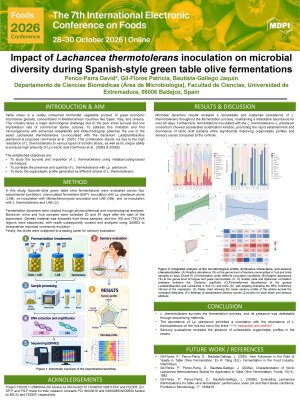
Table olives are among the most widely consumed fermented vegetable products worldwide, with production largely concentrated in Mediterranean countries such as Spain, Italy, and Greece. Despite their economic importance, the industry continues to face technological challenges, particularly the poor initial survival and implantation of commercial starter cultures. This limitation has driven increasing interest in the exploration of alternative microorganisms with enhanced adaptability and biotechnological potential.
In this study, the effect of selected Lachancea thermotolerans strains was evaluated in Spanish-style green table olive fermentations, followed by sequential inoculation with Lactiplantibacillus plantarum. Fermentation dynamics were monitored through physicochemical and microbiological analyses. In addition, a metagenomic approach was applied to characterize microbial community evolution and to assess the possible impact of L. thermotolerans inoculation. Sensory evaluation of the final products was also performed.
Metagenomic results revealed a remarkable and sustained persistence of L. thermotolerans throughout the fermentation process, with detectable abundance maintained for over 90 days. Furthermore, fermentations inoculated with the L. thermotolerans– L. plantarum consortium showed accelerated acidification kinetics, promoting the rapid establishment and dominance of lactic acid bacteria, while improving organoleptic profiles and sensory scores compared to controls.
Overall, the studied L. thermotolerans strains demonstrate significant potential as robust starter cultures for table olive fermentation, particularly due to their exceptional persistence as evidenced by metagenomic analysis. These findings support their application as a strategy to improve fermentation reliability and product quality. Further studies at industrial scale are warranted to confirm their performance under commercial conditions.
Acknowledgements: Project PID2021-125864OA-I00 funded by MCIN/AEI/10.13039/ 501100011033/ and FEDER. Besides, David Penco-Parra and Patricia Gil-Flores thank for their research contracts PCI IN000616 and IN00028609 funded by MCIN and FEDER, respectively.
Keywords
Table olives
Lachancea thermotolerans
Metabardcoding aproaches
Sensory profiling.
Poster
FOODS2026 POSTER.pdf
MODELLING THE COMBINED EFFECTS OF pH AND TEMPERATURE ON BIOFILM FORMATION DYNAMICS OF A MULTIDRUG RESISTANCE STRAIN OF STAPHYLOCOCCUS AUREUS
Effect of hydrothermal–microwave pretreatment on tocopherol retention and acidity evolution in canola oil during storage