Event submissions
Published
This submission belongs to the session C. Food Physicochemistry & Analysis of the event The 7th International Electronic Conference on Foods
Published date
23 Oct, 2026
Academic Editor
 Joana S. Amaral
Citation
Josefina Arocas, Nahuel Matías Lepphaille, Ignacio Echeverría, Mariana Robalo Santos, Maria Belen Fernandez, Oxidative Changes in Canola Oil during Storage as Affected by Hydrothermal–Microwave Pretreatment, in Proceedings of The 7th International Electronic Conference on Foods, 28 October–30 October 2026, MDPI: Basel, Switzerland
Share
Email
Facebook
Twitter
LinkedIn
Oxidative Changes in Canola Oil during Storage as Affected by Hydrothermal–Microwave Pretreatment

Josefina Arocas 1
Nahuel Matías Lepphaille 1,2
Ignacio Echeverría 3
Mariana Robalo Santos 1,2
Maria Belen Fernandez 1,2
1. Seeds and Foods Technology (TECSE); Department of Chemical Engineering and Food Technology, Faculty of Engineering, National University of the Center of the Province of Buenos Aires (UNCPBA), Olavarría, B7400JWI, Argentina
2. Research Center in Physics and Engineering of the Center of the Province of Buenos Aires (CIFICEN), UNCPBA–CICPBA–CONICET, Olavarría, B7400JWI, Argentina
3. Center for Research and Development in Food Cryotechnology (CIDCA), National Scientific and Technical Research Council (CONICET), National University of La Plata (UNLP), La Plata, Buenos Aires, Argentina
Abstract
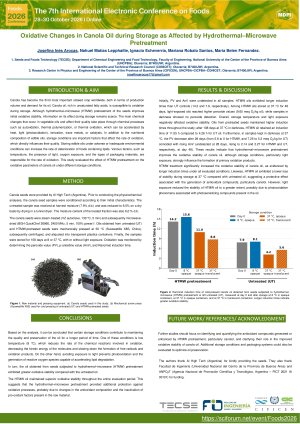
Canola oil, rich in unsaturated fatty acids, is susceptible to oxidation during storage. While hydrothermal–microwave (HTMW) pretreatment of seeds improves initial oxidative stability1, information on its effect during storage remains scarce. This study evaluated the effect of HTMW pretreatment on the oxidative parameters of canola oil under different storage conditions.
Canola seeds were steam-treated (autoclave VZ, 130°C, 5 min) and microwave-dried (BGH QuickChef 36960, 2450 MHz, 5 min, 100% power)1. Oils from untreated (UT) and HTMW-pretreated seeds were mechanically pressed at 50 °C (Susweetlife X8S, China) and stored for 108 days at 8 or 37°C, with or without light exposure. Oxidation was monitored via peroxide value (PV), p-anisidine value (AnV) and Rancimat induction time.
Initially, PV and AnV were undetected in all samples. HTMW oils exhibited longer induction times than UT controls (14.2 and 7.9, respectively). Among HTMW oils stored at 37 °C for 48 days, light-exposed oils reached higher peroxide values (9.65 meq O2/kg oil), while samples in darkness showed no peroxide detection. Overall, storage temperature and light exposure negatively affected oxidative stability. Oils from pretreated seeds maintained higher induction times throughout the study; after 108 days at 37 °C in darkness, HTMW oil retained an induction time of 11.05 h compared to 4.26 h for UT oil. Furthermore, in samples kept in darkness at 37 °C, the PV decrease after 28 days (from 5.8 to 0 for HTMW, and 7.25 to 5.3 meq O2/kg for UT) coincided with rising AnV (undetected at 28 days, rising to 2.14 and 2.27 for HTMW and UT, respectively, at day 48).
These results indicate that hydrothermal–microwave pretreatment improves the oxidative stability of canola oil, although storage conditions, particularly light exposure, strongly influence the formation of primary oxidation products.
Keywords
canola oil
oxidative stability
hydrothermal treatment
microwave
storage
Poster
Poster Congreso Josefina.pdf
Carvacrol and organic acids marination in chicken fillets. An antimicrobial and antioxidant approach.
Development and Characterization of an innovative Artisanal Cider Production Using alternative ingredients