Event submissions
Published
This submission belongs to the session C. Food Physicochemistry & Analysis of the event The 7th International Electronic Conference on Foods
Published date
23 Oct, 2026
Academic Editor
 Joana S. Amaral
Citation
Guilherme Cerejo, Ana Coelho Marques, Maria Manuela Malhado Simões Ribeiro, Ana Rita F. Coelho, Development and Characterization of an innovative Artisanal Cider Production Using alternative ingredients, in Proceedings of The 7th International Electronic Conference on Foods, 28 October–30 October 2026, MDPI: Basel, Switzerland
Share
Email
Facebook
Twitter
LinkedIn
Development and Characterization of an innovative Artisanal Cider Production Using alternative ingredients

Guilherme Cerejo 1

Ana Coelho Marques 1,2
Maria Manuela Malhado Simões Ribeiro 1,2

Ana Rita F. Coelho 1,2
1. Earth Sciences Department of NOVA School of Sciences and Technology, Campus de Caparica, 2829-516 Caparica, Portugal
2. GeoBioTec Research Center, NOVA University Lisbon, 2829-516 Caparica, Portugal
Abstract
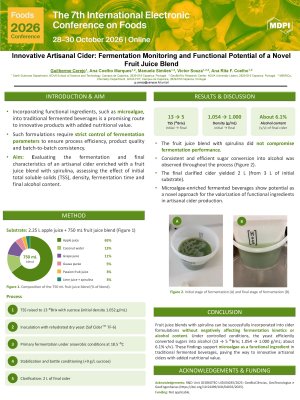
The development of new craft cider ou Artisanal cider recipes that incorporate alternative ingredients requires precise control of fermentation parameters to ensure product quality, process efficiency, and consistency across batches. This study evaluated the influence of the initial total soluble solids (TSS) content, density, and fermentation time on fermentation kinetics, alcohol production, and the final characteristics of an artisanal cider formulated from a blend of fruit juices.
The fermentation consisted of 3 L of substrate prepared from 2.25 L of natural apple juice and a supplementary mixture containing apple juice, grape juice, coconut water, and spirulina. To optimize the content of fermentable sugars, the initial TSS was adjusted from 11.5 to 13 °Brix by adding sucrose, resulting in an initial density of 1.052 g/mL. The mixture was inoculated with rehydrated active dry yeast and fermented under anaerobic conditions at 18 - 19 °C. After primary fermentation, the cider underwent racking, aging, and bottle conditioning with the addition of sugar (9 g/L)
Monitoring of the fermentation revealed stable and efficient sugar conversion throughout the entire process. The specific gravity decreased progressively from 1.052 to 1.030 g/mL, which corresponded to an alcohol content of 5% (v/v). The final product had a density of 1.000 g/mL, 5 °Brix, and an alcohol content of approximately 6% (v/v). The overall process yielded 2 L of clarified cider.
The results demonstrate that systematic monitoring of °Brix and density is a robust tool for controlling fermentation kinetics, allowing for the optimization of alcohol yield and ensuring the reproducibility and consistency of the process in artisanal cider production. Furthermore, the findings support the successful incorporation of alternative ingredients into cider formulations without compromising fermentation performance.
Keywords
Artisanal cider
Fermentation kinetics
Alternative ingredients
Alcohol content
Poster
Poster_Cider_Spirulina_Foods2026.pdf
Oxidative Changes in Canola Oil during Storage as Affected by Hydrothermal–Microwave Pretreatment
A Proof-of-Concept ImageJ/Fiji Workflow for Single-Cell Analysis of Lipid Accumulation in Oleaginous Yeasts