Event submissions
Published
This submission belongs to the session D. Food Microbiology & Biotechnologies of the event The 7th International Electronic Conference on Foods
Published date
23 Oct, 2026
Academic Editor
 Efstathios Giaouris
Citation
Aleksandra Piotrowicz, Agata Fabiszewska, Katarzyna Wierzchowska, A Proof-of-Concept ImageJ/Fiji Workflow for Single-Cell Analysis of Lipid Accumulation in Oleaginous Yeasts, in Proceedings of The 7th International Electronic Conference on Foods, 28 October–30 October 2026, MDPI: Basel, Switzerland
Share
Email
Facebook
Twitter
LinkedIn
A Proof-of-Concept ImageJ/Fiji Workflow for Single-Cell Analysis of Lipid Accumulation in Oleaginous Yeasts

Aleksandra Piotrowicz 1

Agata Fabiszewska 1

Katarzyna Wierzchowska 1
1. WULS/SGGW, Institute of Food Sciences, Department of Chemistry, Nowoursynowska 166 St., 02-776 Warsaw, Poland
Abstract
Sustainable bioprocess development would benefit from accessible and reproducible approaches for assessing microbial lipid accumulation across strains and cultivation conditions. Oleaginous yeasts are promising producers of single-cell oil (SCO), but conventional lipid quantification methods are often time-consuming, destructive, or poorly suited to capturing single-cell heterogeneity. Image-based analysis may therefore provide a useful complementary approach for early-stage screening, particularly when intracellular lipid distribution and cell-to-cell variability are relevant.
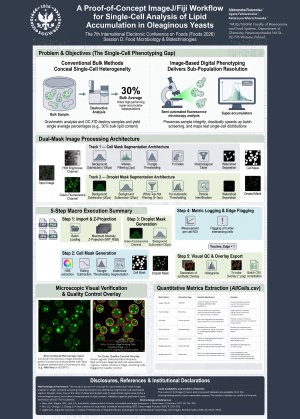
Here, we present a proof-of-concept ImageJ/Fiji workflow for semi-automated single-cell analysis of intracellular lipid accumulation in oleaginous yeasts. The workflow was developed using representative unpublished fluorescence microscopy images from preliminary lipid-staining experiments. Yeast cells are stained with a lipid-selective fluorophore, such as Nile Red, and imaged under controlled fluorescence microscopy settings. Images are analyzed in Fiji/ImageJ using a macro-assisted batch workflow. Cell regions are segmented from the bright-field or brightness channel, while lipid-rich structures are detected from the green fluorescence channel after background correction, White Top Hat enhancement, automatic thresholding, and particle analysis. Segmentation overlays are used for visual quality control.
The workflow is designed to extract descriptors such as lipid-droplet number per cell, droplet area fraction, integrated fluorescence intensity, and distribution-based measures of population heterogeneity. Quality-control steps, including overlay inspection and illumination assessment, are included to support consistent analysis and reduce manual interpretation.
This concept is intended as a preliminary image-analysis approach for comparing lipid accumulation patterns under different experimental conditions, including carbon source, C/N ratio, cultivation time, and stress induction. Future work will focus on validating ImageJ/Fiji-derived parameters against reference lipid measurements, including gravimetric lipid content and fatty-acid profiling, to assess their suitability for screening and comparative phenotyping.
Overall, the proposed workflow may support image-based phenotyping of lipid accumulation in oleaginous yeasts and early-stage comparison of microbial candidates for SCO-oriented bioprocess development.
Keywords
ImageJ/Fiji
oleaginous yeasts
lipid droplets
intracellular lipid accumulation
single-cell analysis
single-cell oil
fluorescence microscopy
Poster
A Proof-of-Concept ImageJFiji Workflow for Single Cell Analysis of Lipid Accumulation in Oleaginous Yeasts.pdf
Development and Characterization of an innovative Artisanal Cider Production Using alternative ingredients
Genotype × Environment Interactions Govern the Biochemical Composition and FTIR Spectral Fingerprint of Fig (Ficus carica L.) Seed Oil