Event submissions
Published
This submission belongs to the session C. Food Physicochemistry & Analysis of the event The 7th International Electronic Conference on Foods
Published date
23 Oct, 2026
Academic Editor
 Joana S. Amaral
Citation
Milica Vidić, Nevena Grujić-Letić, Branislava Teofilović, Emilia Gligorić, Application of lactic acid-based natural deep eutectic solvents for the extraction of phenolic compounds from winter savory, in Proceedings of The 7th International Electronic Conference on Foods, 28 October–30 October 2026, MDPI: Basel, Switzerland
Share
Email
Facebook
Twitter
LinkedIn
Application of lactic acid-based natural deep eutectic solvents for the extraction of phenolic compounds from winter savory

Milica Vidić 1
Nevena Grujić-Letić 1
Branislava Teofilović 1
Emilia Gligorić 1
1. Department of Pharmacy, Faculty of Medicine, University of Novi Sad, Hajduk Veljkova 3, 21000 Novi Sad, Serbia
Abstract
Satureja montana L. (Lamiaceae), known as winter savory, is an aromatic plant native to the Balkan Peninsula, valued for its use as a culinary spice. A diverse range of secondary metabolites, including phenolic compounds, contributes to the reported antioxidant, antidiabetic, anti-inflammatory, analgesic, and antimicrobial potential of this plant. Natural deep eutectic solvents (NADES) are systems designed according to the principles of green chemistry, with demonstrated high efficiency in the extraction of phenolics. The use of NADES, particularly those based on food-grade components, offers a sustainable and potentially food-compatible extraction approach for recovering bioactive compounds. Therefore, the aim of this study was to evaluate the applicability of lactic acid-based NADES in microwave-assisted extraction (MAE) of S. montana herb, with a focus on their efficiency in extracting selected phenolic compounds compared with water and ethanol.
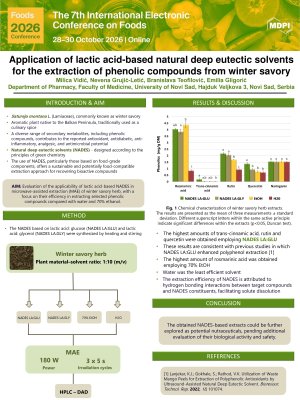
Two NADES systems were prepared by heating and stirring, using food compatible components - lactic acid as the hydrogen bond donor and glucose or glycerol as hydrogen bond acceptors. In addition to NADES, water and 70% ethanol were used as extraction solvents. MAE was carried out in three 5-second cycles, at a microwave power of 180 W. The chemical profile of the extracts was assessed by High-Performance Liquid Chromatography (HPLC).
Rosmarinic acid, trans-cinnamic acid, rutin, quercetin, and naringenin were identified and quantified by HPLC. Extracts obtained using lactic acid:glucose system contained higher levels of rutin, quercetin, naringenin, and trans-cinnamic acid than those obtained with other solvents. Ethanol was more effective for rosmarinic acid extraction, while water was the least efficient solvent.
The obtained NADES-based extracts could be further explored as potential nutraceuticals, pending additional evaluation of their biological activity and safety.
Acknowledgments: This work was supported by the Provincial Secretariat for Higher Education and Scientific Research, Province of Vojvodina (Grant No. 003874431 2025 09418 003 000 000 001).
Keywords
Satureja
Green Extraction
NADES
HPLC
Phenolics
Poster
S.montana.pdf
Cryogenic Pre-treatment of Grape must before winemaking: Effect on must and wine physico-chemical and sensory profiles
Antiglycation Activity of Plant Extracts Evaluated through the Kinetics of Advanced Glycation End Product (AGE) Formation in Model Systems and Apple Juice