Event submissions
Published
This submission belongs to the session B. Nutritional & Functional Foods of the event The 7th International Electronic Conference on Foods
Published date
23 Oct, 2026
Academic Editor
 Manuel Viuda-Martos
Citation
GIULIANA SILVINA SELING, Pilar Buera, Verónica María Busch, Antiglycation Activity of Plant Extracts Evaluated through the Kinetics of Advanced Glycation End Product (AGE) Formation in Model Systems and Apple Juice, in Proceedings of The 7th International Electronic Conference on Foods, 28 October–30 October 2026, MDPI: Basel, Switzerland
Share
Email
Facebook
Twitter
LinkedIn
Antiglycation Activity of Plant Extracts Evaluated through the Kinetics of Advanced Glycation End Product (AGE) Formation in Model Systems and Apple Juice

GIULIANA SILVINA SELING 1
Pilar Buera 2

Verónica María Busch 3,4
1. Institute of Food Technology and Chemical Processes (ITAPROQ), Department of Industries, Faculty of Exact and Natural Sciences, University of Buenos Aires (UBA) and CONICET, Ciudad Autónoma de Buenos Aires, 1428, Argentina
2. Faculty of Exact and Natural Sciences, University of Buenos Aires (UBA) and CONICET, Ciudad Autónoma de Buenos Aires, 1428, Argentina
3. Instituto de Ciencia y Tecnología de Alimentos de Entre Ríos (ICTAER), Universidad Nacional de Entre Ríos- Consejo Nacional de Investigaciones Científicas y Técnicas , Entre Ríos, Argentina
4. Facultad de Bromatología, Universidad Nacional de Entre Ríos- Consejo Nacional de Investigaciones Científicas y Técnicas , Entre Ríos, Argentina
Abstract
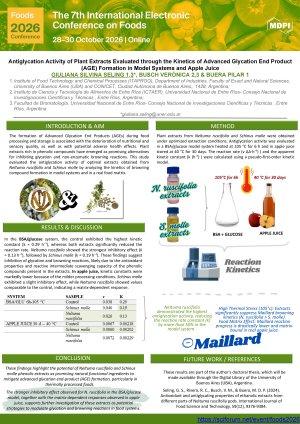
The formation of Advanced Glycation End Products (AGEs) during food processing and storage is associated with the deterioration of nutritional and sensory quality, as well as with potential adverse health effects. Plant extracts rich in phenolic compounds have emerged as promising alternatives for inhibiting glycation and non-enzymatic browning reactions. This study evaluated the antiglycation activity of optimal extracts obtained from Neltuma ruscifolia and Schinus molle by analyzing the kinetics of browning compound formation in model systems and in a real food matrix. Antiglycation activity was assessed in a BSA/glucose model system heated at 105 °C for 6 h and in apple juice stored at 40 °C for 30 days. The reaction rate (v, ΔA·h⁻¹) and the apparent kinetic constant (k, h⁻¹) were calculated using a pseudo-first-order kinetic model. In the BSA/glucose system, the control exhibited the highest kinetic constant (k = 0.29 h⁻¹), whereas both extracts significantly reduced the reaction rate. Neltuma ruscifolia showed the strongest inhibitory effect (k = 0.13 h⁻¹), followed by Schinus molle (k = 0.19 h⁻¹). These findings suggest inhibition of glycation and browning reactions, likely due to the antioxidant properties and reactive intermediate scavenging capacity of the phenolic compounds present in the extracts. In apple juice, kinetic constants were markedly lower because of the milder processing conditions. Schinus molle exhibited a slight inhibitory effect, while Neltuma ruscifolia showed values comparable to the control, indicating a matrix-dependent response. The results demonstrate the potential of these extracts as natural antiglycation agents, particularly in thermally processed foods, supporting their possible application as functional ingredients to reduce AGE formation.
Keywords
ADVANCED GLYCATION END PRODUCTS (AGES)
PHENOLIC COMPOUNDS
NELTUMA RUSCIFOLIA
SCHINUS MOLLE
KINETICS.
Poster
P1 - 2 Antiglycation.pdf
Application of lactic acid-based natural deep eutectic solvents for the extraction of phenolic compounds from winter savory
High-Temperature Ohmic Heating as a Strategy to Improve Resistant Starch Type 5 Formation in Corn Starches with Different Amylose Contents