Event submissions
Published
This submission belongs to the session D. Food Microbiology & Biotechnologies of the event The 7th International Electronic Conference on Foods
Published date
23 Oct, 2026
Academic Editor
 Efstathios Giaouris
Citation
Giuseppe Amato, Francesca Coppola, Florinda Fratianni, Patrizio Tremonte, Beatrice De Giulio, Jesus Fernando Ayala Zavala, Gockhan Zengin, Vincenzo De Feo, Raffaele Coppola, Filomena Nazzaro, Sustainable Valorization of Berry Seed By-Products: Effects of Blackcurrant and Raspberry Seed Oils on Sessile-Cell Metabolism in Bacterial Biofilms of Food and Public Health Relevance, in Proceedings of The 7th International Electronic Conference on Foods, 28 October–30 October 2026, MDPI: Basel, Switzerland
Share
Email
Facebook
Twitter
LinkedIn
Sustainable Valorization of Berry Seed By-Products: Effects of Blackcurrant and Raspberry Seed Oils on Sessile-Cell Metabolism in Bacterial Biofilms of Food and Public Health Relevance

Giuseppe Amato 1
Francesca Coppola 2
Florinda Fratianni 3

Patrizio Tremonte 4
Beatrice De Giulio 3

Jesus Fernando Ayala Zavala 5

Gockhan Zengin 6

Vincenzo De Feo 1

Raffaele Coppola 4

Filomena Nazzaro 3
1. DIFARMA-University of Salerno, Via Giovanni Paolo II, 132, 84084 Fisciano (SA), Italy
2. Department of Agricultural Sciences, University of Naples Federico II, Piazza Carlo di Borbone 1, 80055 Portici, Italy
3. Institute of Food Sciences, CNR-ISA, Via Roma 64, 83100 Avellino, Italy
4. Department of Agricultural, Environmental and Food Sciences (DiAAA)-University of Molise, Via de Sanctis snc, 86100 Campobasso, Italy
5. Research Center for Food and Development A. C., Gustavo Enrique Astiazaran Rosas No. 46, La Victoria, Building E, Hermosillo 83304, Sonora, Mexico
6. Physiology and Biochemistry Laboratory, Department of Biology, Science Faculty, Selcuk University, 42130 Konya, Turkey
Abstract
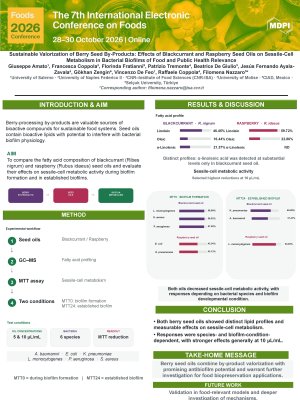
The recovery of value-added compounds from agro-industrial by-products represents a sustainable strategy for developing novel functional ingredients. Berry seed oils, often discarded during fruit processing, are rich in bioactive lipids and may represent promising natural antibiofilm agents for controlling biofilm-forming bacteria relevant to food safety and public health. This study comparatively investigated the fatty acid composition of blackcurrant (Ribes nigrum) and raspberry (Rubus idaeus) seed oils and evaluated their effects on the metabolic activity of sessile cells in immature and mature bacterial biofilms. Fatty acid profiles were determined by GC–MS, while the metabolic activity of sessile cells was evaluated by the MTT reduction assay against immature (MTT0) and mature (MTT24) biofilms formed by Acinetobacter baumannii, Escherichia coli, Klebsiella pneumoniae, Listeria monocytogenes, Pseudomonas aeruginosa, and Staphylococcus aureus. Oils were tested at 5 and 10 μL/mL. Blackcurrant seed oil contained high proportions of α-linolenic (21.37%), linoleic (46.45%), and oleic acids (16.44%), whereas raspberry seed oil was enriched in linoleic (59.72%) and oleic acids (22.86%) and lacked detectable α-linolenic acid. Despite these compositional differences, both oils reduced the metabolic activity of sessile cells, particularly at 10 μL/mL. In immature biofilms, blackcurrant seed oil showed the greatest reduction in sessile-cell metabolic activity against L. monocytogenes (58.00%), S. aureus (58.52%), and P. aeruginosa (57.50%), whereas raspberry seed oil was more effective against E. coli (42.34%) and K. pneumoniae (43.13%). In mature biofilms, raspberry seed oil reduced sessile-cell metabolic activity by up to 54.46% against L. monocytogenes, whereas blackcurrant seed oil achieved reductions of 46.69% against K. pneumoniae and 37.41% against A. baumannii. These findings support the sustainable valorization of berry-processing by-products and identify berry seed oils as promising natural antibiofilm agents for food biopreservation strategies aimed at reducing biofilm-associated microbial persistence.
Keywords
Berry seed oils
Agro-industrial by-products
Bacterial biofilms
Sessile-cell metabolism
Food biopreservation
Fatty acid composition
Poster
Berry_seed_oils_poster_Foods2026_2.pdf
High-Temperature Ohmic Heating as a Strategy to Improve Resistant Starch Type 5 Formation in Corn Starches with Different Amylose Contents
Glucose Reduction in NFC Apple Juice by Immobilized Glucose Oxidase/Catalase: Quality and Safety Assessment