Event submissions
Published
This submission belongs to the session S1. Multiple Myeloma of the event The 1st International Online Conference on Hematology
Published date
23 Oct, 2026
Academic Editor
 Claudio Cerchione
Contribution&Funding
Conceptualization,
[Eithar Mohamed] ; [Mohammad-Salar Hosseini]
Methodology,
[Eithar Mohamed] ; [Mohammad-Salar Hosseini]
Investigation,
[Eithar Mohamed] ; [Mohammad-Salar Hosseini]
Data curation,
[Mohammad-Salar Hosseini]
Writing - original draft,
[Mohammad-Salar Hosseini]
Writing - review,
[editing] ; [Eithar Mohamed]
Funding: --
Citation
Eithar Mohamed, Mohammad-Salar Hosseini, Mitochondrial glutaminase inhibitor telaglenastat (CB-839) in multiple myeloma: a systematic review of preclinical evidence, in Proceedings of The 1st International Online Conference on Hematology, 28 October–30 October 2026, MDPI: Basel, Switzerland
Share
Email
Facebook
Twitter
LinkedIn
Mitochondrial glutaminase inhibitor telaglenastat (CB-839) in multiple myeloma: a systematic review of preclinical evidence

Eithar Mohamed 1
Mohammad-Salar Hosseini 2,3
1. Centre for Biomedicine, University of Hull, Hull, UK
2. Hematology and Oncology Research Center, Tabriz University of Medical Sciences, Tabriz, 51666, Iran
3. Research Center for Evidence-Based Medicine, Iranian EBM Center: A JBI Center of Excellence, Tabriz University of Medical Sciences, Tabriz, 51666, Iran
Abstract
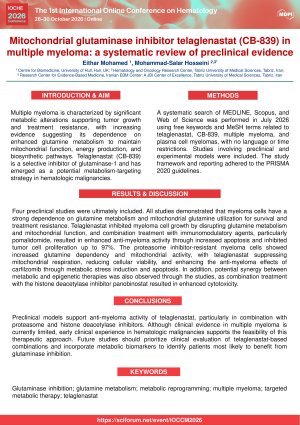
Background: Multiple myeloma is characterized by significant metabolic alterations supporting tumor growth and treatment resistance, with increasing evidence suggesting its dependence on enhanced glutamine metabolism to maintain mitochondrial function, energy production, and biosynthetic pathways. Telaglenastat (CB-839) is a selective inhibitor of glutaminase-1 and has emerged as a potential metabolism-targeting strategy in hematologic malignancies.
Methods: A systematic search of MEDLINE, Scopus, and Web of Science was performed in July 2026 using free keywords and MeSH terms related to telaglenastat, CB-839, multiple myeloma, and plasma cell myelomas, with no language or time restrictions. Studies involving preclinical and experimental models were included. The study framework and reporting adhered to the PRISMA 2020 guidelines.
Results: Four preclinical studies were ultimately included. All studies demonstrated that myeloma cells have a strong dependence on glutamine metabolism and mitochondrial glutamine utilization for survival and treatment resistance. Telaglenastat inhibited myeloma cell growth by disrupting glutamine metabolism and mitochondrial function, and combination treatment with immunomodulatory agents, particularly pomalidomide, resulted in enhanced anti-myeloma activity through increased apoptosis and inhibited tumor cell proliferation up to 97%. The proteasome inhibitor-resistant myeloma cells showed increased glutamine dependency and mitochondrial activity, with telaglenastat suppressing mitochondrial respiration, reducing cellular viability, and enhancing the anti-myeloma effects of carfilzomib through metabolic stress induction and apoptosis. In addition, potential synergy between metabolic and epigenetic therapies was also observed through the studies, as combination treatment with the histone deacetylase inhibitor panobinostat resulted in enhanced cytotoxicity.
Conclusions: Preclinical models support anti-myeloma activity of telaglenastat, particularly in combination with proteasome and histone deacetylase inhibitors. Although clinical evidence in multiple myeloma is currently limited, early clinical experience in hematologic malignancies supports the feasibility of this therapeutic approach. Future studies should prioritize clinical evaluation of telaglenastat-based combinations and incorporate metabolic biomarkers to identify patients most likely to benefit from glutaminase inhibition.
Keywords
Glutaminase inhibition
glutamine metabolism
metabolic reprogramming
multiple myeloma
targeted metabolic therapy
telaglenastat
Poster
Sciforum-208677 - Mohamed E, Hosseini MS.pdf
BCMA-directed CAR-T treatment for Refractory Multiple Myeloma
Oxidative Phosphorylation and mTOR Activation Drive Transcriptomic Divergence in Extramedullary Multiple Myeloma