Event submissions
Published
This submission belongs to the session B. Nutritional & Functional Foods of the event The 7th International Electronic Conference on Foods
Published date
23 Oct, 2026
Academic Editor
 Manuel Viuda-Martos
Citation
Julio Federico Benites, Diego R. Gutierrez, Silvana Cecilia Ruiz, Noelia Alicia Benites, Silvia del Carmen Rodriguez, Chia Sprouts (Salvia hispanica L.): Potential as a Source of Bioactive Compounds, in Proceedings of The 7th International Electronic Conference on Foods, 28 October–30 October 2026, MDPI: Basel, Switzerland
Share
Email
Facebook
Twitter
LinkedIn
Chia Sprouts (Salvia hispanica L.): Potential as a Source of Bioactive Compounds

Julio Federico Benites 1
Diego R. Gutierrez 2

Silvana Cecilia Ruiz 1,3
Noelia Alicia Benites 1
Silvia del Carmen Rodriguez 2
1. Food Science and Technology Institute, Faculty of Agronomy and Agroindustries, National University of Santiago del Estero (UNSE), Santiago del Estero CP4200, Argentina
2. Instituto de Ciencia y Tecnología de los Alimentos. Facultad de Agronomía y Agroindustrias, Universidad Nacional de Santiago del Estero (UNSE). CIBAAL CONICET-UNSE, Villa El Zanjón, Santiago del Estero, Argentina.
3. Instituto Nacional de Tecnología Agropecuaria, Estación Experimental Agropecuaria Santiago del Estero (INTA-EEASE), Santiago del Estero, Argentina
Abstract
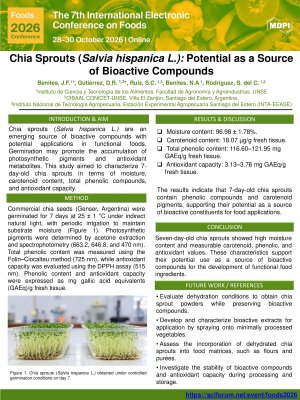
Chia sprouts (CS) (Salvia hispanica L.) constitute an emerging source of bioactive compounds with potential applications in the development of functional foods. During germination, physiological changes occur that may increase the synthesis of photosynthetic pigments and secondary metabolites with antioxidant activity. The objective of this study was to characterize CS in terms of their bioactive compounds, carotenoid content, and moisture. Sprouts were obtained from germinated seeds of the commercial brand Genser (Argentina) and cultivated for 7 days under controlled conditions: an enclosed environment with indirect natural light, ambient temperature maintained at 25 ± 1 °C, and a substrate kept constantly moist through periodic irrigation. Photosynthetic pigments were determined by acetone extraction and spectrophotometric readings at 663.2, 646.8, and 470 nm. Total phenolic compounds were quantified using the Folin–Ciocalteu method (725 nm), and results were expressed as milligrams of gallic acid equivalents (GAEq)/g of fresh tissue. Antioxidant capacity was evaluated using the DPPH method (515 nm) and expressed as mg GAEq/g of fresh tissue. Moisture content in the sprouts was 96.98 ± 1.78%. CS showed an average carotenoid content of 18.07 µg/g of fresh tissue. Total phenolic content and antioxidant capacity ranged from 116.60 to 121.95 and from 3.13 to 3.76 mg GAEq/g of fresh tissue, respectively. The results demonstrate that 7-day-old CS are a source of bioactive compounds, including phenolics and antioxidant photosynthetic pigments. The combination of these metabolites suggests strong potential for CS as a natural functional ingredient. Furthermore, CS could be used for the production of bioactive extracts intended for application in food systems, such as spraying onto minimally processed vegetables, or incorporated as functional additives in matrices like flours or purées through dehydrated CS. These approaches contribute to the development of foods with enhanced nutraceutical value and functional properties.
Keywords
chia sprouts
bioactive compounds
nutraceutical value
functional properties
Poster
Chia Sprouts.pdf
Solid-State Fermentation for Upcycling Agro-Industrial Side Streams into Value-Added Biomass within Circular Food and Bio-Based Systems
Pectooligosaccharides (POS) and Polyphenol-Rich Extracts from Agri-Food By-Products: Valorization of Cocoa (Theobroma cacao) Pod Husk (CPH) through Microwave-Assisted Extraction (MAE)