Event submissions
Published
This submission belongs to the session B. Nutritional & Functional Foods of the event The 7th International Electronic Conference on Foods
Published date
23 Oct, 2026
Academic Editor
 Manuel Viuda-Martos
Citation
Esther Trigueros, Mª Teresa García-Cubero, Susana Lucas, Mónica Coca, Pectooligosaccharides (POS) and Polyphenol-Rich Extracts from Agri-Food By-Products: Valorization of Cocoa (Theobroma cacao) Pod Husk (CPH) through Microwave-Assisted Extraction (MAE), in Proceedings of The 7th International Electronic Conference on Foods, 28 October–30 October 2026, MDPI: Basel, Switzerland
Share
Email
Facebook
Twitter
LinkedIn
Pectooligosaccharides (POS) and Polyphenol-Rich Extracts from Agri-Food By-Products: Valorization of Cocoa (Theobroma cacao) Pod Husk (CPH) through Microwave-Assisted Extraction (MAE)

Esther Trigueros 1,2

Mª Teresa García-Cubero 1,2
Susana Lucas 1,2
Mónica Coca 1,2
1. Institute of Sustainable Processes, University of Valladolid, Valladolid, Spain
2. Department of Chemical Engineering and Environmental Technology, School of Industrial Engineering, University of Valladolid, Valladolid, Spain
Abstract
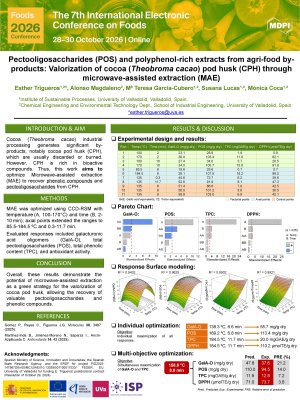
Introduction. Cocoa (Theobroma cacao) industrial processing generates significant by-products volumes that are commonly discarded in landfills or incinerated, causing environmental issues. However, these residues, particularly cocoa pod husk (CPH), contain high-value bioactive compounds. Hence, the main objective of this work was to optimize the Microwave-Assisted Extraction (MAE) of total phenolic compounds and pectooligosaccharides (POS) from CPH.
Methods. MAE optimization was conducted via a Central Composite Design (CCD) with Response Surface Methodology (RSM) with two factors: time (2-10 min) and temperature (100-170 °C). Response variables included extraction yield (EY, %), total phenolic content (TPC, mg GAE/g dry), antioxidant activity (DPPH, µmol TE/g dry), total monosaccharides (TM, mg/g dry), and POS (mg/g dry). The measured pH and the severity factor were used to establish correlations.
Results.
All statistical models (EY, TPC, DPPH, TM, POS) were significant (p ≤ 0.005), showing high accuracy (R2 > 0.9400; R2-adj > 0.8800) and non-significant lack-of-fit (p > 0.05). Temperature significantly impacted EY, TPC, DPPH (p < 0.01), and TM (p < 0.05), while time only influenced EY (p < 0.05). Quadratic term of temperature significantly affected TM and POS (p < 0.01). Positive correlations were observed between TPC and DPPH (r = 0.99), EY (r = 0.95), and severity factor (r = 0.93), while a negative correlation was found with pH (r = -0.97). Optimization maximized TPC and DPPH at 170 °C and 10 min (13.62 mg GAE/g dry and 78.37 µmol TE/g dry), while POS peaked at 138 °C and 6.7 min (36.04 mg/g dry). Multi-objective optimization simultaneously maximizing TPC and POS resulted in 158.7 °C and 8.8 min (predicted TPC: 10.7 mg GAE/g dry; POS: 30.90 mg/g dry; DPPH: 63.85 µmol TE/g dry), with individual desirabilities of 0.7092 and 0.7464, respectively.
Conclusions.
MAE optimization of CPH successfully maximized the recovery of pectooligosaccharides and polyphenols with high antioxidant activity, holding strong potential for functional foods development and industrial food applications.
Keywords
Cocoa By-Products
Design of Experiments
Antioxidant Activity
Response Surface Methodology
Poster
Foods_Trigueros_Esther.pdf
Chia Sprouts (Salvia hispanica L.): Potential as a Source of Bioactive Compounds
Bioprocessing of Olive Mill Wastewater Sludge-Derived Subcritical Water Extracts (SWE) by Lactic Acid Bacteria