Event submissions
Published
This submission belongs to the session D. Food Microbiology & Biotechnologies of the event The 7th International Electronic Conference on Foods
Published date
23 Oct, 2026
Academic Editor
 Efstathios Giaouris
Citation
Sergio Martínez-Terol, Francisco J Barba, Emilia Ferrer, Noelia Pallarés, Francisco J Martí-Quijal, Pedro V Martínez-Culebras, Bioprocessing of Olive Mill Wastewater Sludge-Derived Subcritical Water Extracts (SWE) by Lactic Acid Bacteria, in Proceedings of The 7th International Electronic Conference on Foods, 28 October–30 October 2026, MDPI: Basel, Switzerland
Share
Email
Facebook
Twitter
LinkedIn
Bioprocessing of Olive Mill Wastewater Sludge-Derived Subcritical Water Extracts (SWE) by Lactic Acid Bacteria

Sergio Martínez-Terol 1,2

Francisco J Barba 1,3

Emilia Ferrer 1
Noelia Pallarés 1
Francisco J Martí-Quijal 1
Pedro V Martínez-Culebras 1
1. Research group in Innovative Technologies for Sustainable Food (ALISOST), Department of Preventive Medicine and Public Health, Food Science, Toxicology and Forensic Medicine, Faculty of Pharmacy, Universitat de València, Avenida Vicent Andrés Estellés 22, Valencia, Spain.
2. Building New Energy S.L., Ronda Guglielmo Marconi 13, Edificio Cube-FCI, oficina 3.12, Technology Park of Paterna, 46980 Paterna, València, Spain
3. CIBER for Infectious Diseases (CIBERINFEC), Carlos III Health Institute, 3-5 Monforte de Lemos Street, Pavilion 11, Ground Floor, 28029 Madrid, Spain.
Abstract
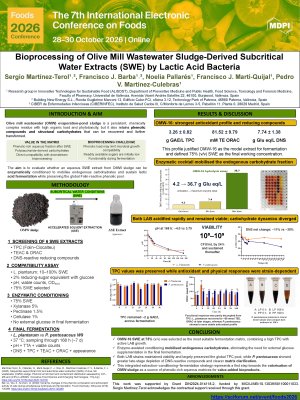
Olive mill wastewater (OMW) and the sludge accumulated in evaporation ponds represent major environmental challenges in Mediterranean olive oil-producing areas because of their high organic load, phytotoxicity and complex composition. Despite their potential as sources of phenolics and fermentable substrates, lactic fermentation of phenolic-rich aqueous extracts obtained from OMW sludge through subcritical water extraction (SWE) remains scarcely investigated. This study evaluated their suitability as fermentation substrates. The selected extract combined the highest phenolic enrichment, representing a high-value but potentially inhibitory matrix, with the greatest reducing sugar content as an endogenous carbon source. Preliminary assays with Lactiplantibacillus plantarum under non-limiting carbon conditions identified a 75% (v/v) extract dilution as the best compromise between microbial compatibility and phenolic retention. Enzymatic conditioning with pectinase, xylanase and cellulase mobilised endogenous carbohydrates, reaching approximately 50 g glucose equivalents/L without external glucose supplementation. Fermentations at 37 ºC for 180 h with L. plantarum and a wheat-associated Pediococcus pentosaceus strain showed rapid acidification, reaching final pH values of approximately 4.0 and 3.75, respectively, sustained viability at 108 - 109 CFU/mL and partial utilisation of reducing sugars during the first 24 h. Total phenolic content remained stable at approximately 2.5 mg GAE/mL, while strain-dependent functional and physicochemical changes, including matrix clarification with P. pentosaceus, were observed. These findings support an integrated extraction-conditioning-fermentation strategy to convert OMW sludge into phenolic-rich, fermentable matrices for the sustainable development of value-added bioproducts.
ACKNOWLEDGEMENTS
This work was supported by Grant DIN2024-014118-2, funded by MICIU/AEI/10.13039/501100011033. Sergio Martínez-Terol acknowledges the contractual support received through this grant.
Keywords
Green extraction; fermentation; enzymatic hydrolysis; phenolic stability; Lactiplantibacillus plantarum; Pediococcus pentosaceus
Poster
POSTER FOODS Martínez Terol et al. 2026.pdf
Pectooligosaccharides (POS) and Polyphenol-Rich Extracts from Agri-Food By-Products: Valorization of Cocoa (Theobroma cacao) Pod Husk (CPH) through Microwave-Assisted Extraction (MAE)
In Silico Assessment of Thymol as a Natural Plant-derived Antibacterial Candidate against Pseudomonas aeruginosa