Event submissions
Published
This submission belongs to the session S2. Acute Myeloid Leukemia of the event The 1st International Online Conference on Hematology
Published date
23 Oct, 2026
Academic Editor
 Claudio Cerchione
Citation
Yasmine Bendimrad, Manzama-Esso Kassang Konzi, Nada Amllal, Hajar Fadili, Iness Erjati, Asmaa Morjan, Lhoussaine Balouch, Youssef Bamou, Molecular, cytogenetic, and immunophenotypic landscape of de novo acute myeloid leukemia: a Moroccan single-center study, in Proceedings of The 1st International Online Conference on Hematology, 28 October–30 October 2026, MDPI: Basel, Switzerland
Share
Email
Facebook
Twitter
LinkedIn
Molecular, cytogenetic, and immunophenotypic landscape of de novo acute myeloid leukemia: a Moroccan single-center study

Yasmine Bendimrad 1
Manzama-Esso Kassang Konzi 2,3
Nada Amllal 3,4
Hajar Fadili 5
Iness Erjati 5
Asmaa Morjan 2,3
Lhoussaine Balouch 2,3
Youssef Bamou 2,3
1. Mohammed VI Faculty of Pharmacy, Mohammed VI University of Sciences and Health (UM6SS), Casablanca, 20000, Morocco
2. Department of Biochemistry, Mohammed VI National Laboratory of Medical Analyses, Casablanca, 20000, Morocco
3. Research Unit, Mohammed VI Center for Research and Innovation, Rabat, 10100, Morocco
4. Department of Medical Genetics, Mohammed VI National Laboratory of Medical Analyses, Casablanca, 20000, Morocco
5. Mohammed VI Faculty of Medicine, Mohammed VI University of Sciences and Health (UM6SS), Casablanca, 20000, Morocco
Abstract
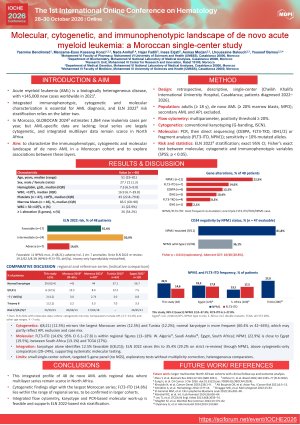
Introduction: Acute myeloid leukemia (AML) is a biologically heterogeneous disease that can arise de novo or secondary to an antecedent disorder. Its risk stratification relies on integrating immunophenotypic, cytogenetic, and molecular data. Such multilayer data remain scarce in North Africa. We aimed to characterize this landscape in a Moroccan cohort of de novo AML and explore associations between these layers.
Methods: We conducted a retrospective, descriptive, single-center study of patients with de novo AML diagnosed between 2022 and 2026 at Cheikh Khalifa International University Hospital, Casablanca, Morocco. Secondary AML and acute promyelocytic leukemia were excluded. Work-up included multiparameter flow cytometry immunophenotyping, conventional karyotyping, and targeted molecular testing (FLT3-ITD/TKD, NPM1, IDH1/2, CEBPA), with risk stratification according to ELN 2022 criteria. Fisher's exact test assessed associations between molecular, cytogenetic, and immunophenotypic variables.
Results: The cohort included 48 patients (median age 51 years; M/F ratio 1.3). NPM1 was mutated in 22.9% of patients, FLT3-ITD in 14.6%, CEBPA in 12.5%, IDH2 in 10.4%, FLT3-TKD in 8.3%, and IDH1 in 2.1%; NPM1/FLT3-ITD was the most frequent co-mutation, and one patient harbored a triple FLT3-ITD/TKD/NPM1 mutation. ELN2022 risk was favorable in 35.4% (including 11 NPM1-mutated and 6 t(8;21) cases), intermediate in 50.0%, and adverse in 14.6%, including two cases with chromosome 7 anomalies. Aberrant CD7 expression was observed in 20.8% of myeloid blasts. NPM1-mutated AML was significantly associated with CD34 negativity (p=0.014), with no other significant cross-layer associations.
Conclusions: This study offers one of the few integrated AML profiles available in North Africa. While cytogenetic patterns align with the largest Moroccan series reported to date, the addition of comprehensive molecular screening provides novel regional insights, such as a comparatively lower FLT3-ITD frequency. These data illustrate the feasibility of integrated flow cytometry, cytogenetic, and molecular work-up in this setting, supporting the relevance of ELN 2022-based risk stratification.
Keywords
Acute myeloid leukemia
molecular profiling
cytogenetics
immunophenotyping
ELN 2022 risk stratification
North Africa
Poster
Poster_IOCHE2026_Bendimrad_Yasmine_vf.pdf
Oxidative Phosphorylation and mTOR Activation Drive Transcriptomic Divergence in Extramedullary Multiple Myeloma
Accelerated Phase of Chediak–Higashi Syndrome with Hemophagocytic Lymphohistiocytosis (HLH): Insights from a Pediatric Case