Event submissions
Published
This submission belongs to the session D. Food Microbiology & Biotechnologies of the event The 7th International Electronic Conference on Foods
Published date
23 Oct, 2026
Academic Editor
 Arun K Bhunia
Citation
Dimitria Bakali, Nektaria-Anastasia Gianneli, Marilena Feizoulla, Konstantina Karathanasi, Efstathios Giaouris, A Comparative Analysis of Turbidity and Impedance Measurements for Rapid Quantification of Bacillus cereus in Milk Across Diverse Temperatures and Salt Concentrations, in Proceedings of The 7th International Electronic Conference on Foods, 28 October–30 October 2026, MDPI: Basel, Switzerland
Share
Email
Facebook
Twitter
LinkedIn
A Comparative Analysis of Turbidity and Impedance Measurements for Rapid Quantification of Bacillus cereus in Milk Across Diverse Temperatures and Salt Concentrations

Dimitria Bakali 1
Nektaria-Anastasia Gianneli 1
Marilena Feizoulla 1
Konstantina Karathanasi 1

Efstathios Giaouris 1
1. Laboratory of Food Microbiology and Hygiene, Department of Food Science and Nutrition, School of the Environment, University of the Aegean, Myrina 81400, Lemnos, Greece
Abstract
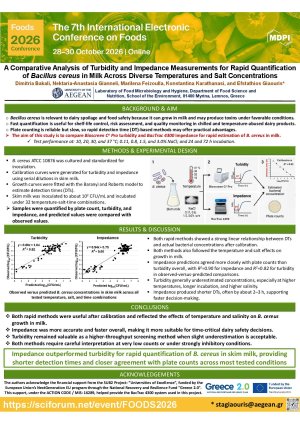
Quickly quantifying Bacillus cereus in milk is crucial for controlling spoilage and toxin-related food safety risks in refrigerated and temperature-abused dairy products. This study evaluated a turbidimetric microplate reader (Bioscreen Co Pro™) versus an impedance-based microbiological analyzer (BacTrac 4300) for rapidly estimating B. cereus levels in skim milk incubated at four temperatures (10, 20, 30, or 37 °C) and four sodium chloride concentrations (0.11, 0.8, 1.5, or 3.0% w/v NaCl). Samples were taken at 24 and 72 h. The instruments produced optical density (OD600 nm) and impedance (M‑value change) time curves, which were fitted to the Baranyi and Roberts model to accurately determine detection times (DTs). These DTs were then correlated with plate counts to generate calibration equations. Both methods demonstrated strong linear relationships between DT and initial inoculum (log10 CFU/mL), as well as between predicted and actual bacterial counts across all temperature-salinity-time conditions (R-squared of 0.82 for turbidity and 0.90 for impedance). Impedance predictions aligned more closely with plate counts, particularly at 20-37 °C and 72 h, while turbidimetric estimates tended to underestimate actual concentrations but still effectively reflected environmental influences on B. cereus growth. Impedance primarily detects metabolically active cells, making it a better indicator of cells relevant to spoilage and toxin production. In contrast, turbidimetry captures signals from viable cells, dead biomass, debris, and spores. Overall, both rapid DT-based techniques provide valuable quantification of B. cereus in milk, but impedance microbiology offers greater accuracy and quicker results for urgent food safety decisions, whereas turbidimetry remains a practical, high-throughput alternative when slight underestimation is acceptable.
Keywords
Bacillus cereus
Milk
Impedance microbiology
Turbidimetry
Detection time (DT)
Predictive microbiology
Dairy food quality.
Poster
Bakali et al._POSTER.pdf
Combined Lacticaseibacillus rhamnosus-Derived Lysate and Cannabis spp. Extracts Enhance Epithelial Restitution in a Caco-2 Wound Healing Model
Optimization of pectin recovery from Williams pear processing by-products through pre- and post-extraction washing treatments