Event submissions
Published
This submission belongs to the session S8. Rare Diseases of the event The 1st International Online Conference on Hematology
Published date
23 Oct, 2026
Academic Editor
 Daniela Cilloni
Citation
Waleed alshukaili, Huda Al-Noumani, Nasser Alsalmi, Medication Adherence and Health Beliefs Among Patients with Sickle Cell Disease in Oman: A Cross-Sectional Study, in Proceedings of The 1st International Online Conference on Hematology, 28 October–30 October 2026, MDPI: Basel, Switzerland
Share
Email
Facebook
Twitter
LinkedIn
Medication Adherence and Health Beliefs Among Patients with Sickle Cell Disease in Oman: A Cross-Sectional Study

Waleed alshukaili 1
Huda Al-Noumani 1
Nasser Alsalmi 1
1. Department of Adult Health and Critical Care, College of Nursing, Sultan Qaboos University, Muscat, Oman.
Abstract
Introduction:
Sickle cell disease (SCD) is a common inherited hematological disorder in Oman, associated with recurrent complications and increased healthcare utilization. Medication adherence is essential for improving clinical outcomes; however, adherence remains suboptimal. Patients’ beliefs about medications are known to influence adherence behavior. This study aimed to assess medication adherence and examine its relationship with health beliefs among patients with SCD in Oman.
Methods:
A cross-sectional study was conducted among 152 patients with SCD attending the National Center for the Treatment of Hematology and Bone Marrow Transplantation in Oman. Medication adherence was measured using the Medication Adherence Report Scale (MARS-5), and health beliefs were assessed using the Beliefs about Medicines Questionnaire (BMQ-12). Descriptive statistics, Pearson correlation, and linear regression analyses were performed.
Results:
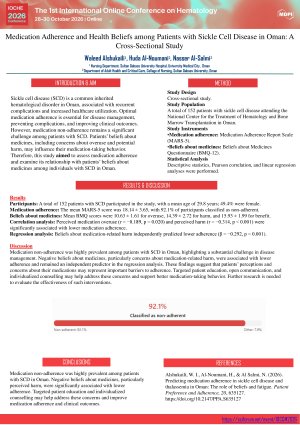
The mean age was 29.8 years, with a balanced gender distribution (49.4% female). The mean MARS-5 score was 18.14 ± 3.65, with 92.1% classified as non-adherent. Mean BMQ scores were 10.63 ± 1.61 (Overuse), 14.39 ± 2.72 (Harm), and 15.93 ± 1.99 (Benefit). Negative beliefs were significantly associated with lower adherence, including overuse (r = –0.189, p = 0.020) and harm (r = –0.314, p < 0.001). Beliefs about harm independently predicted non-adherence (β = –0.292, p = 0.001).
Conclusion:
Medication adherence among patients with SCD in Oman is markedly low. Negative health beliefs, particularly perceived harm, are significant predictors of non-adherence. Addressing these beliefs through targeted educational interventions may improve adherence and clinical outcomes.
Keywords
Medication Adherence
Oman
SCD
Poster
Waleed, Oman.pdf
Accelerated Phase of Chediak–Higashi Syndrome with Hemophagocytic Lymphohistiocytosis (HLH): Insights from a Pediatric Case
Left Ventricular Aneurysm after MINOCA in Antiphospholipid Syndrome: A Single-Center Cohort Study