Event submissions
Published
This submission belongs to the session S8. Rare Diseases of the event The 1st International Online Conference on Hematology
Published date
23 Oct, 2026
Academic Editor
 Daniela Cilloni
Citation
Alexander Shatskiy, Left Ventricular Aneurysm after MINOCA in Antiphospholipid Syndrome: A Single-Center Cohort Study, in Proceedings of The 1st International Online Conference on Hematology, 28 October–30 October 2026, MDPI: Basel, Switzerland
Share
Email
Facebook
Twitter
LinkedIn
Left Ventricular Aneurysm after MINOCA in Antiphospholipid Syndrome: A Single-Center Cohort Study

Alexander Shatskiy 1
1. Faculty of Fundamental Medicine, Chelyabinsk State University, Chelyabinsk, Russia
Abstract
Introduction
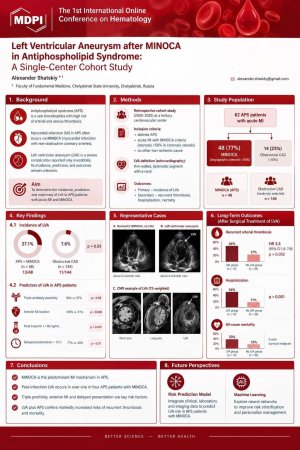
Antiphospholipid syndrome (APS) is a rare thrombophilia. Myocardial infarction (MI) in APS often occurs via MINOCA (myocardial infarction with non-obstructive coronary arteries). Left ventricular aneurysm (LVA) is a severe complication reported only anecdotally. Its incidence, predictors, and outcomes remain unknown.
Methods
We conducted a retrospective cohort study (2005–2025) at a tertiary cardiovascular center, including patients with definite APS and acute MI meeting MINOCA criteria: angiographic stenosis <50% in coronary vessels and no other identifiable non-ischemic cause. LVA was defined by echocardiography as a thin-walled, dyskinetic segment with a neck. The primary outcome was incidence of LVA; secondary outcomes included recurrent thrombosis, hospitalization, and mortality.
Results
Among 62 APS patients with acute MI, 48 (77%) met MINOCA criteria. LVA developed in 13 of 48 MINOCA patients (27.1%), versus 11 of 144 (7.6%) randomly selected patients with obstructive coronary disease (p=0.03). Predictors of LVA in APS patients included triple-antibody positivity (92% vs. 57%, p=0.02), anterior MI location (100% vs. 51%, p=0.002), peak troponin I>60 ng/mL (p<0.001), and delayed presentation >12 hours (77% vs. 34%, p=0.01). At median follow-up of 3.5 years, LVA after surgical treatment was associated with higher rates of recurrent arterial thrombosis (46% vs. 17%, HR 3.5, 95% CI 1.6–7.8, p=0.002) and hospitalization (54% vs. 11%, p<0.001). All-cause mortality was 33% in the LVA group (5-year survival endpoint).
Conclusions
MINOCA is the predominant MI mechanism in APS. Post-infarction LVA occurs in over one in four APS patients with MINOCA. Triple positivity, anterior MI, and delayed presentation are key risk factors. LVA plus APS confers markedly increased risks of recurrent thrombosis and mortality.
Keywords
Antiphospholipid Antibody Syndrome
MINOCA
Left Ventricular Aneurysm
Poster
Poster hematology Shatskiy A.pdf
Medication Adherence and Health Beliefs Among Patients with Sickle Cell Disease in Oman: A Cross-Sectional Study
Beyond Physiological Monocytes: Diagnostic Challenges in Infantile AML with KAT6A::CREBBP Fusion