Event submissions
Published
This submission belongs to the session B. Nutritional & Functional Foods of the event The 7th International Electronic Conference on Foods
Published date
23 Oct, 2026
Academic Editor
 Manuel Viuda-Martos
Citation
Paula Sette, Aldana Siliquini, Ramona del Carmen Maturano, Daniela Salvatori, Optimization of pectin recovery from Williams pear processing by-products through pre- and post-extraction washing treatments, in Proceedings of The 7th International Electronic Conference on Foods, 28 October–30 October 2026, MDPI: Basel, Switzerland
Share
Email
Facebook
Twitter
LinkedIn
Optimization of pectin recovery from Williams pear processing by-products through pre- and post-extraction washing treatments

Paula Sette 1
Aldana Siliquini 1
Ramona del Carmen Maturano 1

Daniela Salvatori 1
1. Engineering Faculty, National Comahue University (UNCOma)/ National Scientific and Technical Research Council (CONICET)/ Institute for Research and Development in Process Engineering, Biotechnology, and Alternative Energies (PROBIEN), Neuquén, 8300, Argentina
Abstract
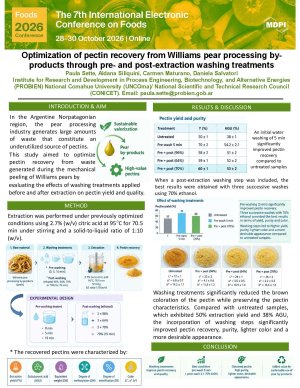
The valorization of agro-industrial by-products represents a sustainable strategy for producing high-value food ingredients. In the Argentine Norpatagonian region, the pear processing industry generates large amounts of waste that constitute an underutilized source of pectins. This study aimed to optimize pectin recovery from waste generated during the mechanical peeling of Williams pears by evaluating the effects of washing treatments applied before and after extraction on pectin yield and quality. Extraction was performed under previously optimized conditions using 2.7% (w/v) citric acid at 95°C for 70.5 min under stirring and a solid-to-liquid ratio of 1:10 (w/v). Pre-washing was performed by water immersion for 0, 5, and 15 min, whereas post-washing comprised four treatments: three successive washes with ethanol at a constant concentration of 96%, 64%, or 70%, and a separate treatment consisting of immersion in 70% ethanol for 15 min. The recovered pectins were characterized by extraction yield (Y%), galacturonic acid content (AGU), equivalent weight (EW), degree of methoxylation (DM), degree of esterification (DE), and color (L*, a*, b*). An initial water washing of 5 min significantly improved pectin recovery compared to untreated samples, resulting in a yield of 70 ± 2% and an AGU content of 54.2 ± 2.1%. When a post-extraction washing step was included, the best results were obtained with three successive washes using 70% ethanol. This treatment significantly reduced the brown coloration of the pectin (L*= 26 ± 2, a*= 2.2 ± 0.5, and b*= 10.6 ± 1.3) while preserving the pectin characteristics (60 ± 1% extraction yield, 53 ± 2% AGU, 8.2 ± 0.5% DM, 5849 ± 21 g/mol EW, and 98 ± 2% DE). Compared with untreated samples, which exhibited 50% extraction yield and 38% AGU, the incorporation of washing steps significantly improved pectin recovery, purity, lighter color and a more desirable appearance.
Keywords
pear waste
pectin
extraction process
optimization
Poster
Poster sciforum 203229.pdf
A Comparative Analysis of Turbidity and Impedance Measurements for Rapid Quantification of Bacillus cereus in Milk Across Diverse Temperatures and Salt Concentrations
In vitro and in situ antifungal activity of potential probiotic lactic acid bacteria from maize: evaluation of enzyme production and mycotoxin degradation.