Event submissions
Published
This submission belongs to the session G. Food Safety, Toxicology & Quality of the event The 7th International Electronic Conference on Foods
Published date
23 Oct, 2026
Academic Editor
 Esther Sendra
Citation
Adeola Oluwakemi Aasa, Samkelo Malgas, Mapitsi S. Thantsha, In vitro and in situ antifungal activity of potential probiotic lactic acid bacteria from maize: evaluation of enzyme production and mycotoxin degradation., in Proceedings of The 7th International Electronic Conference on Foods, 28 October–30 October 2026, MDPI: Basel, Switzerland
Share
Email
Facebook
Twitter
LinkedIn
In vitro and in situ antifungal activity of potential probiotic lactic acid bacteria from maize: evaluation of enzyme production and mycotoxin degradation.

Adeola Oluwakemi Aasa 1
Samkelo Malgas 1
Mapitsi S. Thantsha 1
1. Department of Biochemistry, Genetics and Microbiology, University of Pretoria, Pretoria, 0028, South Africa.
Abstract
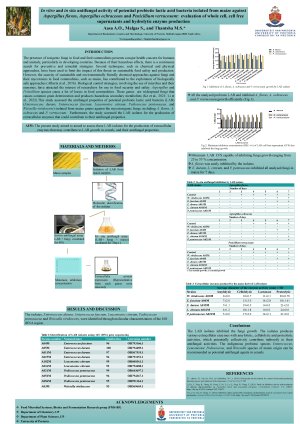
Introduction: The presence of toxigenic fungi in food, including cereals, presents a major health concern for humans and animals, particularly in developing countries. Biological detoxification strategies are being considered as alternatives to the conventional techniques due to their specificity, environmental friendliness, and ability to preserve the nutritional and sensory quality of foods. This study investigated the antifungal properties and enzyme production of bacterial cell and cell-free supernatants (CFS) of potential probiotic lactic acid bacteria (LAB) (Enterococcus durans, Enterococcus faecium, Leuconostoc citreum, Pediococcus pentosaceus, and Weissella viridescens) against toxigenic A. flavus, A. ochraceus and P. verrucosum. Methods: LAB isolates from maize were screened for antifungal, amylolytic, cellulolytic, lactonase and proteolytic activities using agar well diffusion, mould spot, and in-situ assays on maize grains. The ability of LAB to degrade AFB1 and OTA was evaluated using ultra-performance liquid chromatography mass spectrometry. Results: Whole viable cells of all the tested LAB, as well as their CFS, efficiently inhibited growth of A. flavus, A. ochraceus and P. verrucosum. Neutralised CFS (nCFS) had little or no inhibitory effect on all tested fungi. The LAB prevented the growth of toxigenic fungi on maize grains for 7 days, except for E. faecium A04M, where growth was evident after 5 days. Furthermore, all the LAB showed cellulolytic and proteolytic activities. Amylolytic activity was observed in all isolates except W. viridescens A03M. W. viridescens A03M, E. faecium A04M and P. pentosaceus A021M exhibited lactonase activity. The LAB isolates completely degraded AFB1, while OTA degradation ranged from 25% to75%. Conclusions: The production of hydrolytic enzymes and lactonase activity, along with other antifungal metabolites, by the LAB could provide them with a broad spectrum of direct and indirect antagonistic activities against mycotoxigenic fungi. These findings revealed the promising potential of LAB in effective mycotoxin detoxification strategies for cereal-based products.
Keywords
Food safety
maize
toxigenic fungi
enzymes
mycotoxin
Poster
FOODS CONFERENCE PRESENTATION SLIDE 19-10-26.pdf
Optimization of pectin recovery from Williams pear processing by-products through pre- and post-extraction washing treatments
Contamination and Nutritional Quality in Date-Derived Natural Sweeteners from Algeria and Tunisia