Event submissions
Published
This submission belongs to the session G. Food Safety, Toxicology & Quality of the event The 7th International Electronic Conference on Foods
Published date
23 Oct, 2026
Academic Editor
 Esther Sendra
Citation
Giovanna Gabrielle Fatima de Souza, Elen Romão Sartori, Gustavo Fix, Giulia Santos Silveira, Development and validation of voltammetric method of synthetic dye amaranth in foods employing a boron doped diamond electrode, in Proceedings of The 7th International Electronic Conference on Foods, 28 October–30 October 2026, MDPI: Basel, Switzerland
Share
Email
Facebook
Twitter
LinkedIn
Development and validation of voltammetric method of synthetic dye amaranth in foods employing a boron doped diamond electrode

Giovanna Gabrielle Fatima de Souza 1
Elen Romão Sartori 1
Gustavo Fix 1
Giulia Santos Silveira 1
1. Laboratory of Electroanalytical and Sensors. Department of Chemistry. State University of Londrina. P.O. Box: 10.011, Londrina, Paraná, Brazil.
Abstract
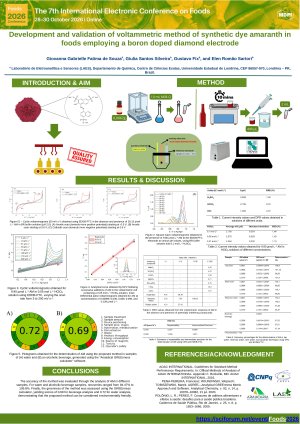
The synthetic dye amaranth (AM; Bordeaux Red S), also known as INS 123, is widely used in the food industry to color foods and beverages. The use of this dye by some countries highlights the importance of its analysis to ensure consumer safety. For this reason, this work describes the development and validation of a voltammetric method for quality control analysis of beverages containing AM. Voltammetric measurements were performed in a conventional three-electrode single-compartment glass cell, comprising a boron-doped diamond electrode (BDDE; working electrode), an Ag/AgCl (3.0 mol L-1 KCl; reference electrode), and a platinum plate (auxiliary electrode), connected to a potentiostat/galvanostat. AM exhibits three oxidation peaks and one reduction peak. The second oxidation peak (~0.97 V) was selected for AM determination due to its higher current intensity. The experimental conditions employed for AM determination were 0.05 mol L-1 HClO4 as the supporting electrolyte and a cathodically pretreated BDDE. Under these conditions, the analytical curve was obtained by differential pulse voltammetry over the concentration range from 0.010 to 0.128 µmol L-1, with a detection limit of 0.005 µmol L-1. Selectivity was assessed against water ions (Fe2+, Ca2+, Zn2+, Mg2+, K+, Na+, SO2-, PO43-, and NO3-) and dyes; interference was observed from brilliant blue, sunset yellow, and tartrazine yellow in concentrations higher than 1:1 in proportion (AM: dye). Precision showed relative standard deviation values below 7%. The accuracy of the method was evaluated through the analysis of AM in different samples. For water and alcoholic beverage samples, recoveries ranged from 94.47% to 109.8%. Finally, the greenness of the method was assessed using the GREEnness calculator, yielding scores of 0.69 for beverage analysis and 0.72 for water analysis, demonstrating that the proposed method can be considered environmentally friendly.
Keywords
Amaranth
Quality Control
Boron-Doped Diamond Electrode.
Poster
foods conference.pdf
Impact of Subsurface Localized Irrigation on Physicochemical Quality and Postharvest Stability of Table Grapes
Harnessing Philippine Seaweeds for Nutrient-Dense Snack Development