Event submissions
Published
This submission belongs to the session B. Nutritional & Functional Foods of the event The 7th International Electronic Conference on Foods
Published date
23 Oct, 2026
Academic Editor
 Manuel Viuda-Martos
Citation
Mark Anthony Casas Lat, Ma. Jesukristina M. Lumanglas, Marielli Katherine C. Untalan, Harnessing Philippine Seaweeds for Nutrient-Dense Snack Development, in Proceedings of The 7th International Electronic Conference on Foods, 28 October–30 October 2026, MDPI: Basel, Switzerland
Share
Email
Facebook
Twitter
LinkedIn
Harnessing Philippine Seaweeds for Nutrient-Dense Snack Development

Mark Anthony Casas Lat 1
Ma. Jesukristina M. Lumanglas 2
Marielli Katherine C. Untalan 2,3
1. College of Engineering Technology, Batangas State University, Alangilan, Philippines
2. Department of Chemical Engineering, College of Engineering, Batangas State University, Alangilan, Philippines
3. Food Innovation Center, Batangas State University, Alangilan, Philippines
Abstract
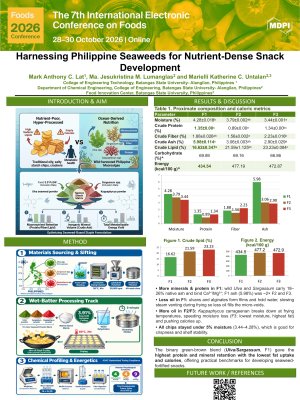
Introduction: Incorporating marine macroalgae into expanded starch matrices offers a sustainable strategy for functional food development, yet determining how these ingredients affect the final macronutrient profile remains critical. This study established the proximate compositional baseline of tapioca starch chips enriched with different combinations of wild-harvested Philippine seaweeds. Methods: Three formulations were evaluated at a fixed 3.91% dry weight inclusion rate: Formulation 1 (Ulva and Sargassum, 50:50), Formulation 2 (Sargassum and Kappaphycus, 50:50), and Formulation 3 (equal parts of Ulva, Sargassum, and Kappaphycus). Pulverized dehydrated seaweeds (40-mesh) were mixed into the starch matrix, steam-gelatinized (5 min), dehydrated (60 °C, 3 h), and deep-fried to induce expansion. Final product parameters were validated using standard replicated AOAC proximate analysis protocols, and energy values were determined via the Atwater conversion system. Results and Discussion: All formulations exhibited low final moisture levels between 3.44% and 4.28%, which is favorable for crispness and shelf stability. Formulation 1 (Ulva/Sargassum) yielded the highest crude protein content at 1.35% and a crude ash content of 5.98%, outperforming F2 (3.06% ash) and F3 (2.90% ash). While deep-frying introduced a substantial lipid profile across all variants—ranging from 16.62% in F1 to 23.23% in F3 (with F2 at 21.59%)—the carbohydrate-dense carrier matrix (66.86%–69.89%) successfully accommodated the dried seaweed powder. Caloric density was highest in F2 (477.19 kcal/100 g), followed by F3 (472.87 kcal/100 g) and F1 (434.54 kcal/100 g). Conclusions: A binary green-brown macroalgae blend (Ulva/Sargassum) enhances crude protein and ash retention while minimizing lipid uptake and total caloric density, providing practical nutritional benchmarks for developing seaweed-incorporated snack products.
Keywords
Sargassum
Kappaphycus)
Tapioca starch matrix
Proximate composition
Crude ash content
Atwater caloric density
Ulva
Poster
HARNESSING PHILIPPINE SEAWEEDS FOR NUTRIENT-DENSE SNACK DEVELOPMENT.pdf
Development and validation of voltammetric method of synthetic dye amaranth in foods employing a boron doped diamond electrode
Proximate analysis, physicochemical and sensory acceptance of crackers formulated with underutilized Artocarpus integer rags