Event submissions
Published
This submission belongs to the session G. Food Safety, Toxicology & Quality of the event The 7th International Electronic Conference on Foods
Published date
23 Oct, 2026
Academic Editor
 Esther Sendra
Citation
Carla Ferraris, Clara Tramuta, Alessandra Provera, Sara Morello, Samantha Lupi, Michelangelo Sabbadini, Daniela Manila Bianchi, Buckwheat as an emerging allergen: a pilot study for its detection in food products by real-time PCR, in Proceedings of The 7th International Electronic Conference on Foods, 28 October–30 October 2026, MDPI: Basel, Switzerland
Share
Email
Facebook
Twitter
LinkedIn
Buckwheat as an emerging allergen: a pilot study for its detection in food products by real-time PCR

Carla Ferraris 1
Clara Tramuta 1,2
Alessandra Provera 1,2
Sara Morello 1,2
Samantha Lupi 1,2
Michelangelo Sabbadini 1,2

Daniela Manila Bianchi 1,2
1. Experimental Zooprophylactic Institute of Piedmont, Liguria and Valle d'Aosta, Via Bologna 148, 10154, Turin, Italy
2. Italian National Reference Center for the Detection of Food Allergens and Substances Causing Food Intolerance (CReNaRiA), Via Bologna 148,10154 Turin, Italy
Abstract
Introduction
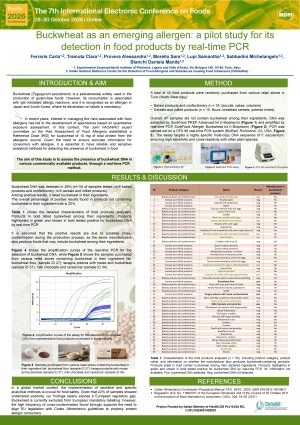
Buckwheat (Fagopyrum esculentum) is a pseudocereal commonly used in gluten-free products. It is recognised as a food allergen in Japan and South Korea. Although buckwheat is not included among the allergens listed in Regulation (EU) No 1169/2011, its inclusion has been proposed by the Codex Alimentarius. Given the need to provide accurate information to allergic consumers, reliable and sensitive methods for its detection in food products are essential. The aim of this study was to assess the presence of buckwheat DNA in commercially food products using a real-time PCR.
Methods
A total of 50 food products were randomly purchased from supermarkets in Turin (North-West Italy): (i) baked products and confectionery (n = 35: biscuits, cakes, crackers) or (ii) cereals and milled products (n = 15: flours, breakfast cereals, polenta mixes). Overall, 47 samples did not contain buckwheat among their ingredients. DNA was extracted by SureFood PREP Advanced kit (r-Biopharm) and amplified by real-time PCR SureFood Allergen Buckwheat kit (r-Biopharm). The assay targets a highly specific multi-copy DNA sequence of F. esculentum, ensuring high sensitivity and cross-reactivity with other plant species.
Results and discussion
Buckwheat DNA was detected in 28% (n=14) of samples tested (n=9 baked products and confectionery, n=5 cereals and milled products). Of these, 3 reported different percentages of buckwheat among their ingredients. It is assumed that the positive results are due to possible cross-contamination during the production process, as the same manufacturers also produce foods that may include buckwheat.
Conclusions
In a global market context, the implementation of sensitive and specific analytical methods is crucial for food safety. Given that 22% of samples showed undeclared positivity, our findings clearly expose a European regulatory gap. Buckwheat is currently excluded from European mandatory labeling; however, the high frequency of cross-contamination found strongly supports the need to align EU legislation with Codex Alimentarius guidelines to properly protect allergic consumers.
Keywords
Food safety
emerging allergen
PCR
Poster
Buckwheat_template.pdf
Proximate analysis, physicochemical and sensory acceptance of crackers formulated with underutilized Artocarpus integer rags
Prebiotic Potential of Dragon fruit (Hylocereus costaricensis) Peel and Pulp on Lactobacillus acidophilus