Event submissions
Published
This submission belongs to the session B. Nutritional & Functional Foods of the event The 7th International Electronic Conference on Foods
Published date
23 Oct, 2026
Academic Editor
 Manuel Viuda-Martos
Citation
NEHA ELANDASSERY SASHA, Dr. Sunil K. Panchal, Dr. Seeja Thomachan Panjikkaran, Dr. Sharon C. L., Dr. Suman K. T., Dr. Deepu Mathew, Dr. Mani Chellappan, Multi-Enzyme Inhibition and Anti-Inflammatory Effects of Dammar Bee Honey: An In Vitro Study, in Proceedings of The 7th International Electronic Conference on Foods, 28 October–30 October 2026, MDPI: Basel, Switzerland
Share
Email
Facebook
Twitter
LinkedIn
Multi-Enzyme Inhibition and Anti-Inflammatory Effects of Dammar Bee Honey: An In Vitro Study

NEHA ELANDASSERY SASHA 1,2

Dr. Sunil K. Panchal 2
Dr. Seeja Thomachan Panjikkaran 1
Dr. Sharon C. L. 1
Dr. Suman K. T. 1
Dr. Deepu Mathew 1
Dr. Mani Chellappan 1
1. Department of Community Science, Kerala Agricultural University, Thrissur, 680656, India
2. School of Science, Western Sydney University, Hawkesbury, Richmond, NSW, 2751, Australia
Abstract
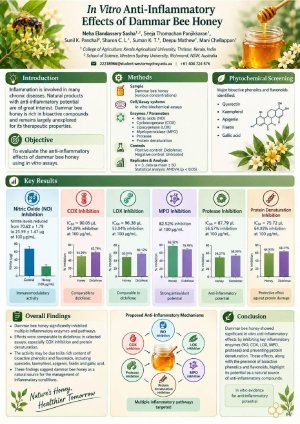
Inflammation plays an important role in the development of many chronic diseases, creating a growing interest in natural compounds with anti-inflammatory potential. Dammar bee honey is a phytochemical rich natural product that remains largely unexplored for its therapeutic properties. The present study investigated the anti-inflammatory activity of dammar bee honey using a series of in vitro biochemical assays targeting different inflammatory pathways. The study evaluated the ability of the honey to inhibit nitric oxide production, cyclooxygenase (COX), lipoxygenase (LOX), myeloperoxidase (MPO), and protease enzymes, along with its effect on protein denaturation. Dammar bee honey showed significant inhibition of nitric oxide production in stimulated cultures (reducing nitrite levels from 70.62 ± 1.79 µg to 21.99 ± 1.47 µg at 100 µg/mL), indicating immunomodulatory activity. It also effectively inhibited COX (IC50 = 90.05 µL; 54.29% at 100 µg/mL), LOX (IC50 = 96.38 µL; 53.04% at 100 µg/mL), MPO (82.52% at 100 µg/mL), and protease (IC50 = 87.79 µL; 56.57% at 100 µg/mL) activities, suggesting strong anti-inflammatory and antioxidant potential. In addition, the honey reduced protein denaturation (IC50 = 75.72 µL; 64.93% at 100 µg/mL), demonstrating its protective effect against inflammatory protein damage. These multi-pathway inhibitory effects are likely attributable to major bioactive phenolics and flavonoids present in the honey, such as quercetin, kaempferol, apigenin, fisetin, and gallic acid, identified through phytochemical screening. The observed effects were comparable to the standard anti-inflammatory drug diclofenac in selected assays, particularly COX inhibition and protein denaturation. The findings suggest that dammar bee honey can act on multiple inflammatory pathways and may serve as a promising natural agent for the management of inflammatory conditions.
Keywords
Dammar bee honey
anti-inflammatory activity
in vitro assays
nitric oxide inhibition
cyclooxygenase (COX)
lipoxygenase (LOX)
myeloperoxidase (MPO)
protease inhibition
protein denaturation
bioactive natural products
Poster
Final Foods2026.pdf
Prebiotic Potential of Dragon fruit (Hylocereus costaricensis) Peel and Pulp on Lactobacillus acidophilus
Maillard Reaction Progression During Storage of Lactose Free Milk Powder Formulated with Maltodextrin and Ultrafiltration Permeate