Event submissions
Published
This submission belongs to the session G. Food Safety, Toxicology & Quality of the event The 7th International Electronic Conference on Foods
Published date
23 Oct, 2026
Academic Editor
 Esther Sendra
Citation
Djordje Kitic, Ljilja Torovic, Processing Contaminants in Foods: A Quarter of a Century of RASFF Notifications Reveal Persistent Food Safety Challenges, in Proceedings of The 7th International Electronic Conference on Foods, 28 October–30 October 2026, MDPI: Basel, Switzerland
Share
Email
Facebook
Twitter
LinkedIn
Processing Contaminants in Foods: A Quarter of a Century of RASFF Notifications Reveal Persistent Food Safety Challenges

Djordje Kitic 1

Ljilja Torovic 1
1. Department of Pharmacy, Faculty of Medicine, University of Novi Sad, 21000 Novi Sad, Serbia
Abstract
Processing contaminants remain a major food safety concern owing to their widespread occurrence across food groups, limited controllability during processing, and adverse health effects, including nephrotoxicity, genotoxicity, and carcinogenicity.
This study investigated the occurrence and distribution of processing contaminants reported through the EU Rapid Alert System for Food and Feed (RASFF) over the past 25 years to evaluate temporal trends, contamination patterns, and the effectiveness of current regulatory and mitigation measures.
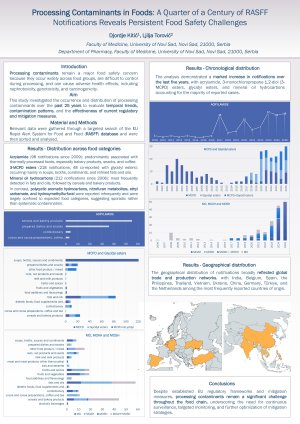
The analysis revealed a marked increase in notifications during the last five years, with acrylamide, 3-monochloropropane-1,2-diol (3-MCPD) esters, glycidyl esters, and mineral oil hydrocarbons accounting for the majority of reported cases. Acrylamide (98 notifications since 2009) was predominantly associated with thermally processed foods, particularly bakery products, snacks, and coffee, whereas 3-MCPD esters (218 notifications, including 48 co-reported with glycidyl esters) occurred mainly in soups, broths, condiments, and refined fats and oils. Mineral oil hydrocarbons (212 notifications since 2006) were most frequently detected in fats and oils, followed by cereals and bakery products. In contrast, polycyclic aromatic hydrocarbons, nitrofuran metabolites, ethyl carbamate, and hydroxymethylfurfural were reported infrequently and were largely confined to expected food categories, suggesting sporadic rather than systematic contamination. The geographical distribution of notifications broadly reflected global production and trade networks, with India, Belgium, Spain, the Philippines, Thailand, Vietnam, Ukraine, China, Germany, Türkiye, and the Netherlands representing the principal countries of origin.
Despite established EU regulatory frameworks and mitigation measures, processing contaminants remain a significant challenge throughout the food chain, underscoring the need for continuous surveillance, targeted monitoring, and further optimization of mitigation strategies.
Keywords
acrylamide
3-MCPD esters
glycidyl esters
mineral oil hydrocarbons
Poster
Process contam.pdf
Maillard Reaction Progression During Storage of Lactose Free Milk Powder Formulated with Maltodextrin and Ultrafiltration Permeate
Autochthonous lactic acid bacteria from Gran Canaria (Canary Islands) enhance the functional properties of goat cheese via modulation of bioactive fatty acids and antioxidant capacity