Event submissions
Published
This submission belongs to the session G. Food Safety, Toxicology & Quality of the event The 7th International Electronic Conference on Foods
Published date
23 Oct, 2026
Academic Editor
 Esther Sendra
Citation
Yashika Jagadish, Rajadurai Murugan, Ranjith D, Evaluation of the Protective Potential of Chitosan-TPP Encapsulated Tamarindus indica Fruit Pulp Extract against Tartrazine-Induced Haematological and Biochemical Alterations in Female Wistar Albino Rats, in Proceedings of The 7th International Electronic Conference on Foods, 28 October–30 October 2026, MDPI: Basel, Switzerland
Share
Email
Facebook
Twitter
LinkedIn
Evaluation of the Protective Potential of Chitosan-TPP Encapsulated Tamarindus indica Fruit Pulp Extract against Tartrazine-Induced Haematological and Biochemical Alterations in Female Wistar Albino Rats

Yashika Jagadish 1
Rajadurai Murugan 1
Ranjith D 2
1. Department of Food Technology, Faculty of Life and Allied Health Sciences, Ramaiah University of Applied Sciences, Bengaluru, India
2. Department of Veterinary Pharmacology and Toxicology, College of Veterinary and Animal Sciences, Mannuthy, Thrissur, Kerala, India
Abstract
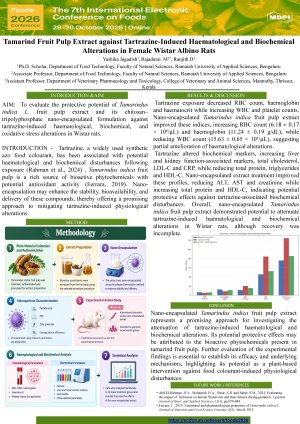
Tartrazine (E102), a synthetic azo dye widely used in beverages, confectioneries, processed foods, and pharmaceutical coatings, induces dose-dependent toxicity via oxidative stress-mediated cellular injury, with females showing heightened susceptibility to haematological, hepatic, renal, and metabolic disturbances. Tamarindus indica L. fruit pulp possesses antioxidant and anti-apoptotic properties, though poor bioavailability limits its therapeutic utility—a constraint nanoencapsulation may help to address. This study evaluated chitosan–tripolyphosphate (TPP)-encapsulated T. indica fruit pulp extract (N-TIFP) against tartrazine-induced toxicity in female Albino Wistar rats, comparing its effects against unencapsulated TIFP and vitamin E. Aqueous TIFP underwent phytochemical screening; N-TIFP was synthesized via ionic gelation, exhibiting a particle size of ~387.9 nm and zeta potential of +14.19 mV. Antioxidant capacity was assessed using DPPH, ABTS, FRAP, and TAC assays. Forty-eight rats were divided into eight groups (n = 6): Normal Control (distilled water, 5 mL/kg), TIFP (400 mg/kg), N-TIFP (equivalent to 400 mg/kg TIFP), Vitamin E (300 mg/kg in 0.01% Tween 80), Tartrazine (15 mg/kg), TIFP+Tartrazine, N-TIFP+Tartrazine, and Vitamin E+Tartrazine, administered orally for 28 days, followed by haematological and biochemical, antioxidant analysis. Data (mean ± SEM) were analysed by one-way ANOVA with Tukey's post-hoc test (p < 0.05). Phytochemical screening confirmed alkaloids, tannins, and saponins, with N-TIFP showing significantly higher antioxidant activity than TIFP across all assays. Tartrazine significantly reduced RBC, haemoglobin, MCV, MCH, and MCHC, while elevating RDW, platelets, lymphocytes, granulocytes, glucose, CRP, liver and kidney markers (ALP, bilirubin, ALT, AST, creatinine), CK-MB, LDL, and total cholesterol, with concurrent HDL and triglyceride reductions. N-TIFP co-administration produced significantly greater attenuation of these alterations than unencapsulated TIFP, with protective effects comparable to vitamin E. This enhanced efficacy is consistent with improved solubility and antioxidant availability via the chitosan–TPP system; bioavailability, cellular uptake, and sustained-release parameters were not directly evaluated. Overall, N-TIFP attenuated tartrazine-induced haematological and biochemical alterations, supporting further investigation of nano formulated T. indica extract against xenobiotic-induced toxicity.
Keywords
Tamarindus indica
tartrazine
chitosan nanoparticles
oxidative stress
serum biochemistry
Wistar albino rats
Poster
MDPI Poster.pdf
Monitoring Antibiotic Residues in Extensively Managed Raw Sheep Milk for Enhanced Food Quality and Safety
Food Safety Education in Slovenian Primary Schools: Evaluation of an Innovative Learning Approach