Event submissions
Published
This submission belongs to the session G. Food Safety, Toxicology & Quality of the event The 7th International Electronic Conference on Foods
Published date
23 Oct, 2026
Academic Editor
 Esther Sendra
Citation
Mojca Jevšnik Podlesnik, Mateja Fekonja, Tadeja Kraner Šumenjak, Food Safety Education in Slovenian Primary Schools: Evaluation of an Innovative Learning Approach, in Proceedings of The 7th International Electronic Conference on Foods, 28 October–30 October 2026, MDPI: Basel, Switzerland
Share
Email
Facebook
Twitter
LinkedIn
Food Safety Education in Slovenian Primary Schools: Evaluation of an Innovative Learning Approach

Mojca Jevšnik Podlesnik 1
Mateja Fekonja 2
Tadeja Kraner Šumenjak 2
1. University of Ljubljana, Faculty of Health Sciences, Ljubljana, Slovenia
2. University of Maribor, Faculty of Agriculture and Life Sciences, Hoče, Slovenia
Abstract
Introduction:
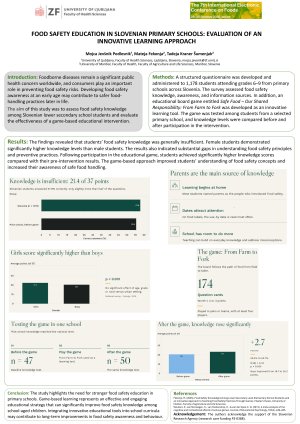
Foodborne diseases remain a significant public health concern worldwide, and consumers play an important role in preventing food safety risks. Developing food safety awareness at an early age may contribute to safer food-handling practices later in life. The aim of this study was to assess food safety knowledge among Slovenian lower secondary school students and evaluate the effectiveness of a game-based educational intervention.
Methods:
A structured questionnaire was developed and administered to 1,178 students attending grades 6–9 from primary schools across Slovenia. The survey assessed food safety knowledge, awareness, and information sources. In addition, an educational board game entitled Safe Food – Our Shared Responsibility: From Farm to Fork was developed as an innovative learning tool. The game was tested among students from a selected primary school, and knowledge levels were compared before and after participation in the intervention.
Results:
The findings revealed that students’ food safety knowledge was generally insufficient. Female students demonstrated significantly higher knowledge levels than male students. The results also indicated substantial gaps in understanding food safety principles and preventive practices. Following participation in the educational game, students achieved significantly higher knowledge scores compared with their pre-intervention results. The game-based approach improved students’ understanding of food safety concepts and increased their awareness of safe food handling.
Conclusions:
The study highlights the need for stronger food safety education in primary schools. Game-based learning represents an effective and engaging educational strategy that can significantly improve food safety knowledge among school-aged children. Integrating innovative educational tools into school curricula may contribute to long-term improvements in food safety awareness and behaviour.
Keywords: food safety; food safety education; primary school students; game-based learning; awareness
Keywords
food safety
food safety education
primary school students
game-based learning
awareness
Poster
Jevšnik et al Foods2026.pdf
Evaluation of the Protective Potential of Chitosan-TPP Encapsulated Tamarindus indica Fruit Pulp Extract against Tartrazine-Induced Haematological and Biochemical Alterations in Female Wistar Albino Rats
Development of Microencapsulated Probiotic Formulation using Spray Drying