Event submissions
Published
This submission belongs to the session B. Nutritional & Functional Foods of the event The 7th International Electronic Conference on Foods
Published date
23 Oct, 2026
Academic Editor
 Manuel Viuda-Martos
Citation
Sundhar B, Vandana K V, Rashmi H.M., Basavaprabhu H.N., Heartwin Amaladhas P, Devaraja H.C., Diwas Pradhan, Harshitha M, Development of Microencapsulated Probiotic Formulation using Spray Drying, in Proceedings of The 7th International Electronic Conference on Foods, 28 October–30 October 2026, MDPI: Basel, Switzerland
Share
Email
Facebook
Twitter
LinkedIn
Development of Microencapsulated Probiotic Formulation using Spray Drying

Sundhar B 1
Vandana K V 1
Rashmi H.M. 1
Basavaprabhu H.N. 1
Heartwin Amaladhas P 2
Devaraja H.C. 3
Diwas Pradhan 4
Harshitha M 2
1. Dairy Microbiology Section, SRS of ICAR-NDRI, Karnal, India
2. Dairy Engineering Section, SRS of ICAR-NDRI, Karnal, India
3. Dairy Technology Section, SRS of ICAR-NDRI, Karnal, India
4. Dairy Microbiology Division, ICAR-NDRI, Karnal, India
Abstract
Lactiplantibacillus plantarum Lp91 (MTCC 5690), a promising probiotic strain with proven safety and efficacy in pre-clinical studies. However, orally-administered probiotics must withstand the harsh gastrointestinal environment and during food processing and storage. Spray drying serves as an efficient method for probiotic encapsulation, enhancing their stability and viability through the use of appropriate wall materials that provides protection against thermal and environmental stresses. Among various wall materials, maltodextrin is widely used due to its high glass transition temperature, which supports the formation of a stable glassy matrix. In this study, Lp91 was encapsulated using maltodextrin combined with denatured whey protein isolate (DWPI) where DWPI forms a protective protein network that shields probiotic cells from harsh processing conditions. The Lp91 was propagated in MRS broth and incubated at 37 °C for 18 h. Following incubation, cellular biomass was harvested and the cells were washed twice with sterile phosphate-buffered saline and incorporated at 10% (w/v) into the feed solution containing 10% (w/v) maltodextrin and 10% (w/v) DWPI. Encapsulation of the probiotic cells was carried out by spray drying under optimized conditions, with an inlet air temperature of 180 °C, out let air temperature of 70 °C and a feed flow rate of 1 mL/min. The obtained encapsulated powder was comprehensively characterized for physicochemical, microbial, and microstructural properties. The moisture content was 3.03±0.05%, and bulk density was 249±0.06 kg/m³. SEM analysis showed mostly spherical particles with smooth to slightly wrinkled surfaces and absence of major fractures indicate good structural integrity and effective encapsulation. Particle size analysis revealed a unimodal distribution, predominantly between 1 and 10 µm. The survival rate of Lp91 after encapsulation was 91.1%, with a final viable population of 8.3×10¹⁰ CFU/g. Finally, the encapsulated probiotic formulation met all the quality criteria to be used as a nutraceutical in foods and dairy products.
Keywords
Lp91
Maltodextrin
DWPI
Spray drying
Probiotic formulation
Poster
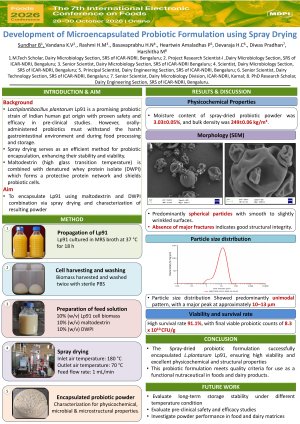
SUNDHAR poster presentation.pdf
Food Safety Education in Slovenian Primary Schools: Evaluation of an Innovative Learning Approach
Discrimination of Species in Raw Milk by Raman Spectroscopy and Principal Component Analysis