Event submissions
Published
This submission belongs to the session C. Food Physicochemistry & Analysis of the event The 7th International Electronic Conference on Foods
Published date
23 Oct, 2026
Academic Editor
 Joana S. Amaral
Citation
Sina Makouie, Joanna Bryś, Jolanta Małajowicz, Characterizing and Optimizing Milk Thistle Pomace Oil and Bioactives Extracted by Ultrasound-Assisted Extraction, in Proceedings of The 7th International Electronic Conference on Foods, 28 October–30 October 2026, MDPI: Basel, Switzerland
Share
Email
Facebook
Twitter
LinkedIn
Characterizing and Optimizing Milk Thistle Pomace Oil and Bioactives Extracted by Ultrasound-Assisted Extraction

Sina Makouie 1

Joanna Bryś 1

Jolanta Małajowicz 1
1. Department of Chemistry, Institute of Food Sciences, Warsaw University of Life Sciences, 159c, Nowoursynowska St., 02-776 Warsaw, Poland
Abstract
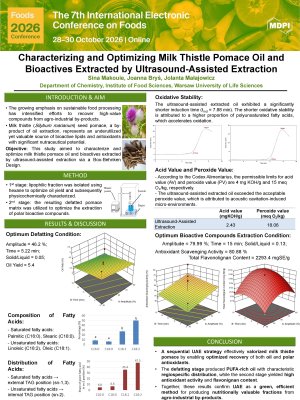
Milk thistle (Silybum marianum L. Gaertn.) is a medicinal plant from the Asteraceae family renowned for its therapeutic and industrial potential. Its seeds contain highly valuable bioactive compounds, including the silymarin complex, unsaturated fatty acids, vitamin E, and diverse phenolics, which contribute significantly to the prevention of cardiovascular diseases. This study implemented a sequential, two-step ultrasound-assisted extraction (UAE) strategy optimized via a Box-Behnken design (BBD). In the first stage, lipophilic fractions were isolated using n-hexane to optimize oil yield. The optimized oil was evaluated for fatty acid profile via gas chromatography (GC), regiospecific distribution, and thermal oxidative properties via Pressure Differential Scanning Calorimetry (PDSC). Quality parameters were further assessed through acid and peroxide value testing. In the second stage, the resulting defatted pomace matrix was utilized to optimize the extraction of polar bioactive compounds (phenols, polyphenols, and flavonoids) using ethanol under UAE.
Analytical results for the optimized oil showed that linoleic acid (C18:2) and oleic acid (C18:1) were the predominant unsaturated fatty acids, complemented by saturated palmitic (C16:0) and stearic (C18:0) acids. Regiospecific analysis indicated that unsaturated fatty acids were preferentially located at the internal (sn-2) position, whereas saturated fatty acids occupied the external (sn-1,3) positions. The oil exhibited an oxidation induction time of 7.88 minutes via PDSC. While the acid value remained safely within the permissible range, a slightly elevated peroxide value was observed. This behavior is attributed to acoustic cavitation-induced micro-environments, where localized radical formation promotes early-stage primary oxidation on highly sensitive polyunsaturated chains. The subsequent secondary extraction yielded a considerable total phenolic and flavonoid content from the defatted matrix.
In conclusion, the optimized sequential UAE method serves as an efficient, green, non-thermal approach to successfully fractionate milk thistle pomace, preserving key structural oil characteristics while concurrently liberating premium bioactive components for health and nutrition applications.
Keywords
Milk thistle seed pomace
Ultrasound-assisted extraction
Phenolic compounds
Poster
Sci-forum- 7th Edition-Sina Makouie.pdf
Discrimination of Species in Raw Milk by Raman Spectroscopy and Principal Component Analysis
Tree Age Effects on Chemical Composition of cv. Verdeal Transmontana Olive Oil: Young vs Centenarian Trees