Event submissions
Published
This submission belongs to the session B. Nutritional & Functional Foods of the event The 7th International Electronic Conference on Foods
Published date
23 Oct, 2026
Academic Editor
 Manuel Viuda-Martos
Citation
Kushlani Nalinka Deshapriya, Kanchana Abeysekera, Kaushalya Abeysekera, Sameera Samarakoon, Umapriyatharshini Rajagopalan, Jayantha Senanayake, Sirimal Premakumara, Comparative Evaluation of the Cytotoxic Effects of Selected New Improved and Traditional Red and White Sri Lankan Rice (Oryza sativa L.) Varieties on Human Colorectal Cancer (Caco-2) Cells, in Proceedings of The 7th International Electronic Conference on Foods, 28 October–30 October 2026, MDPI: Basel, Switzerland
Share
Email
Facebook
Twitter
LinkedIn
Comparative Evaluation of the Cytotoxic Effects of Selected New Improved and Traditional Red and White Sri Lankan Rice (Oryza sativa L.) Varieties on Human Colorectal Cancer (Caco-2) Cells

Kushlani Nalinka Deshapriya 1
Kanchana Abeysekera 1
Kaushalya Abeysekera 2
Sameera Samarakoon 3
Umapriyatharshini Rajagopalan 3
Jayantha Senanayake 4
Sirimal Premakumara 5
1. Department of Agricultural Technology, Faculty of Technology, University of Colombo, Pitipana, Homagama 10206, Sri Lanka
2. Department of Biosystems Technology, Faculty of Technology, University of Sri Jayewardenepura, Pitipana, Homagama 10206, Sri Lanka
3. Institute of Biochemistry, Molecular Biology and Biotechnology, University of Colombo, Colombo 03 00300, Sri Lanka
4. Rice Research and Development Institute, Bathalagoda 60400, Sri Lanka
5. Department of Biosystems Technology, Faculty of Technology, General Sir John Kotelawala Defence University, Ratmalana 10390, Sri Lanka
Abstract
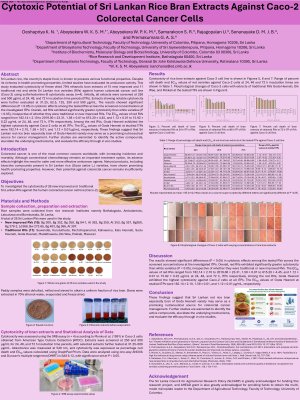
Sri Lankan rice, the country's staple food, is known to possess various functional properties. Despite its richness in health-promoting properties, limited studies have evaluated its anticancer activity. This study evaluated cytotoxicity of freeze dried 70% ethanolic bran extracts of 15 new improved and 11 traditional red and white Sri Lankan rice varieties (RVs) against human colorectal cancer cell line (Caco-2) using sulforhodamine-B cytotoxicity assay (n=4). Initially, all extracts were screened at 250 and 500 µg/mL at 24, 48, and 72 h incubation time periods (ITPs). Extracts showing notable cytotoxicity were further evaluated at 31.25, 62.5, 125, 250 and 500 µg/mL. The results showed significant differences (P < 0.05) in cytotoxic effects among the tested RVs across the screened concentrations at the investigated ITPs. Overall, red RVs exhibited significantly greater cytotoxicity than white varieties (P < 0.05), irrespective of whether they were traditional or new improved RVs. The EC₅₀ values of red RVs ranged from 182.14 ± 2.10 to 2019.00 ± 23.31, 1.58 ± 0.01 to 615.20 ± 4.45, and 1.12 ± 0.01 to 15.92 ± 0.22 µg/mL at 24, 48, and 72 h, ITPs respectively. Among the red RVs, Goda Heeneti exhibited the highest cytotoxicity against Caco-2 cells at all ITPs. The EC₅₀ values of Goda Heeneti at studied ITPs were 182.14 ± 2.10, 1.58 ± 0.01, and 1.12 ± 0.01 µg/mL, respectively. These findings suggest that Sri Lankan red rice bran especially bran of Goda Heeneti variety may serve as a promising nutraceutical source for cancer management. Further studies are warranted to identify the active compounds, elucidate the underlying mechanisms, and evaluate the efficacy through in vivo studies.
Keywords
Cytotoxicity
colorectal cancer
new improved & traditional rice
Sri Lankan rice
rice bran
Poster
Poster Sciforum-202961 FOODS 2026.pdf
Tree Age Effects on Chemical Composition of cv. Verdeal Transmontana Olive Oil: Young vs Centenarian Trees
Accumulation of microplastics in tomato (Solanum lycopersicum L.)