Event submissions
Published
This submission belongs to the session B. Nutritional & Functional Foods of the event The 7th International Electronic Conference on Foods
Published date
23 Oct, 2026
Academic Editor
 Manuel Viuda-Martos
Citation
Susana Diez, Lorena Franceschinis, Daniela Salvatori, Development of gluten-free premixes with an improved nutritional profile: effect of Jerusalem artichoke powder on the technological quality of millet–legume blends, in Proceedings of The 7th International Electronic Conference on Foods, 28 October–30 October 2026, MDPI: Basel, Switzerland
Share
Email
Facebook
Twitter
LinkedIn
Development of gluten-free premixes with an improved nutritional profile: effect of Jerusalem artichoke powder on the technological quality of millet–legume blends

Susana Diez 1
Lorena Franceschinis 1

Daniela Salvatori 1
1. Instituto de Investigación y Desarrollo en Ingeniería de Procesos, Biotecnología y Energías Alternativas (CONICET-Universidad Nacional del Comahue), 1400 Buenos Aires St, Neuquén 8300, Argentina
Abstract
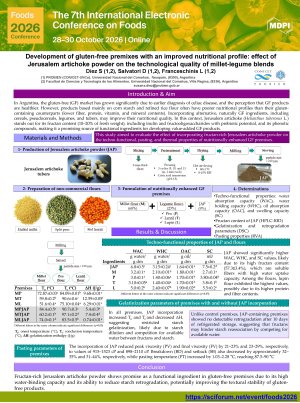
Gluten-free (GF) foods are produced mainly from refined flours and starches, resulting in products with low nutritional value. The incorporation of legume flours and fiber-rich plant ingredients to improve the nutritional profile of GF products remains a technological challenge. This study evaluated the effect of incorporating a fructan-rich dried Jerusalem artichoke (Helianthus tuberosus L.) powder (JAP) on the techno-functional, pasting, and thermal properties of nutritionally enhanced GF premixes. Three formulations were prepared using 68% millet flour (M) as the base ingredient, 23% legume flour —pea (P), red lentil (R), or lupin (L)— and 9% JAP. The techno-functional properties of JAP and the individual flours were determined by measuring water absorption capacity (WAC), water holding capacity (WHC), oil absorption capacity (OHC), and swelling capacity (SC). Pasting properties were assessed using a Rapid Visco Analyzer, while thermal properties were evaluated by differential scanning calorimetry in millet–legume premixes with JAP (MPJAP, MRJAP, and MLJAP) and without JAP (MP, MR, and ML). Compared with the flours, JAP exhibited significantly higher WAC (6.8±0.5 g H2O/g d.b), WHC (3.15±0.24 g H2O/g d.b), and SC (7.5±0.2 mL/g d.b) values. The incorporation of JAP resulted in lower peak (915-1523 cP) and final viscosities (898-2110 cP), higher pasting temperatures (87.5-90 ºC), and lower setback values (320-1135 cP), suggesting a reduced tendency toward amylose retrogradation. In addition, JAP modified the thermal behavior of the blends by increasing gelatinization temperatures (64-88 ºC), reducing gelatinization enthalpy (0.7-7.4 J/g), and inhibiting starch retrogradation in all formulations. These findings suggest that JAP regulates water availability within the system, delaying starch gelatinization and limiting molecular reorganization. This effect is mainly attributed to fructans, although legume components may also contribute. Overall, JAP provides technological advantages for the development of gluten-free premixes with improved processing stability and the potential to produce higher-quality gluten-free products.
Keywords
Helianthus tuberosus L.
fructans
gluten-free
techno-functional properties
pasting properties
termal properties
Poster
poster final Diez y col.pdf
Influence of Replacing Raw Cocoa with Cocoa Shell Husk on Chemical Composition, Physicochemical Properties, and Sensory Attributes of Apple-Cocoa Fruit Leathers
Stabilizer-dependent physical stability of vitamin-fortified coconut milk alternatives