Event submissions
Published
This submission belongs to the session C. Food Physicochemistry & Analysis of the event The 7th International Electronic Conference on Foods
Published date
23 Oct, 2026
Academic Editor
 Joana S. Amaral
Citation
Andrzej Oleniacz, Marek Rzeszotarski, Rita Brzezińska, Anna Bryś, Joanna Bryś, Stabilizer-dependent physical stability of vitamin-fortified coconut milk alternatives, in Proceedings of The 7th International Electronic Conference on Foods, 28 October–30 October 2026, MDPI: Basel, Switzerland
Share
Email
Facebook
Twitter
LinkedIn
Stabilizer-dependent physical stability of vitamin-fortified coconut milk alternatives

Andrzej Oleniacz 1
Marek Rzeszotarski 1
Rita Brzezińska 2
Anna Bryś 3

Joanna Bryś 2
1. Witpol Sp. Z o.o., Stodzew 54B; 08-441 Parysów, Poland
2. Department of Chemistry, Institute of Food Sciences, Warsaw University of Life Sciences, 159c, Nowoursynowska St., 02-776 Warsaw, Poland
3. Faculty of Biology and Biotechnology, Warsaw University of Life Sciences – SGGW, Warsaw, Poland
Abstract
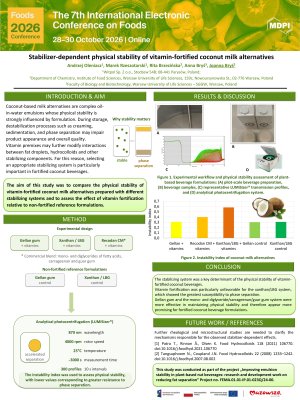
Plant-based coconut beverages are oil-in-water emulsions in which lipid-phase separation may reduce visual quality, shelf-life stability, and consumer acceptance. The incorporation of functional ingredients, including vitamin premixes, may additionally affect interactions between fat droplets, hydrocolloids, and the aqueous phase. Therefore, the selection of an appropriate stabilizing system is essential for maintaining the physical stability of fortified coconut milk alternatives.
The aim of this preliminary study was to evaluate the physical stability of vitamin-fortified coconut beverage formulations stabilized with selected food-grade hydrocolloid systems: gellan gum, xanthan/locust bean gum blend, and a commercial emulsifier/stabilizer blend composed of mono- and diglycerides of fatty acids, carrageenan, and guar gum (Recodan CM). Non-fortified coconut beverage variants stabilized with gellan gum or xanthan/locust bean gum were used as reference samples. Stability was assessed using analytical photocentrifugation with a LUMiSizer dispersion analyzer at 870 nm over approximately 3000 s. The instability index was used as the main parameter describing the tendency toward sedimentation and lipid-phase separation.
The stability of vitamin-fortified coconut beverages depended on the stabilizing system. Fortified samples containing gellan gum showed instability index values ranging from 0.183 to 0.372, while formulations with the commercial emulsifier/stabilizer blend showed intermediate values of 0.379-0.414. In contrast, vitamin-fortified samples stabilized with the xanthan/locust bean gum blend showed the highest instability index values, ranging from 0.564 to 0.600, indicating a greater tendency toward phase separation under accelerated test conditions. The non-fortified reference variants showed instability index values of 0.295–0.307. Compared with the respective non-fortified controls, vitamin fortification markedly increased instability in the xanthan/locust bean gum system (0.564–0.600 vs. 0.305), whereas the gellan gum system showed a variable response, with fortified samples ranging from 0.183 to 0.372 compared with 0.295-0.307 for the non-fortified reference samples.
The results indicate that vitamin fortification affected the physical stability of coconut milk alternatives in a stabilizer-dependent manner, with a clear destabilizing effect in the xanthan/locust bean gum system but no consistent unidirectional effect in the gellan gum system. Formulations containing gellan gum or the mono- and diglyceride/carrageenan/guar gum stabilizing system showed lower instability than those stabilized with xanthan/locust bean gum.
Keywords
coconut milk alternative
emulsion stability
vitamin fortification
hydrocolloids
lipid-phase separation
Poster
Stabilizer-dependent physical stability of vitamin-fortified coconut milk alternatives_Bryś J..pdf
Development of gluten-free premixes with an improved nutritional profile: effect of Jerusalem artichoke powder on the technological quality of millet–legume blends
Development and Nutritional Characterization of Multispecies Seaweed Chips from Philippine Seaweeds