Event submissions
Published
This submission belongs to the session C. Food Physicochemistry & Analysis of the event The 7th International Electronic Conference on Foods
Published date
23 Oct, 2026
Academic Editor
 Joana S. Amaral
Citation
Mark Anthony Casas Lat, Ma. Jesukristina M. Lumanglas, Marielli Katherine C. Untalan, Development and Nutritional Characterization of Multispecies Seaweed Chips from Philippine Seaweeds, in Proceedings of The 7th International Electronic Conference on Foods, 28 October–30 October 2026, MDPI: Basel, Switzerland
Share
Email
Facebook
Twitter
LinkedIn
Development and Nutritional Characterization of Multispecies Seaweed Chips from Philippine Seaweeds

Mark Anthony Casas Lat 1
Ma. Jesukristina M. Lumanglas 2
Marielli Katherine C. Untalan 2,3
1. College of Engineering Technology, Batangas State University, Alangilan, Philippines
2. Department of Chemical Engineering, College of Engineering, Batangas State University, Alangilan, Philippines
3. Food Innovation Center, Batangas State University, Alangilan, Philippines
Abstract
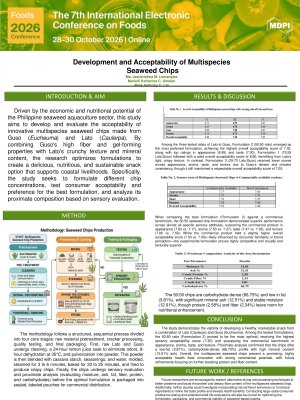
Seaweeds are valuable marine resources with potential for utilization in value-added food products. This study explored the development and proximate composition of multispecies seaweed chips formulated from Caulerpa and Eucheuma species available in the Philippines. Three formulations with Caulerpa:Eucheuma ratios of 75:25, 50:50, and 25:75 were developed and evaluated during the product development process. The 50:50 formulation was selected for proximate characterization based on its overall product acceptability. Proximate composition was determined using applicable methods of the Association of Official Analytical Chemists (AOAC). The selected formulation contained 12.01% moisture, 12.51% ash, 2.58% crude protein, 2.34% crude fiber, 3.81% crude fat, and 66.75% carbohydrate. These results provide baseline information on the proximate composition of a chip product formulated by combining Caulerpa and Eucheuma. The findings support the feasibility of developing multispecies seaweed chips using locally available Philippine seaweeds and provide a basis for further formulation and process optimization. The study does not establish specific health or nutritional benefits beyond the proximate composition determined. Future studies should investigate storage stability, detailed nutritional and functional properties, and appropriately designed and ethically approved consumer or sensory evaluations. Overall, the study provides preliminary compositional information that may support further development of seaweed-based snack products.
Keywords
seaweed chips
proximate composition
functional foods
nutritional innovation
Philippine seaweeds
sustainable snacks
Poster
Development of Multispecies Seaweed Chips.pdf
Stabilizer-dependent physical stability of vitamin-fortified coconut milk alternatives
Post-Fermentation Incorporation of Grape Pomace into Yogurt: Effects on Bioactive Compound Content and Antioxidant Activity