Event submissions
Published
This submission belongs to the session B. Nutritional & Functional Foods of the event The 7th International Electronic Conference on Foods
Published date
23 Oct, 2026
Academic Editor
 Manuel Viuda-Martos
Citation
Stephanie Christine do Prado, Victoria Cortes Mach, Josiane Roberto Domingues, Christiane Queiroz, Post-Fermentation Incorporation of Grape Pomace into Yogurt: Effects on Bioactive Compound Content and Antioxidant Activity, in Proceedings of The 7th International Electronic Conference on Foods, 28 October–30 October 2026, MDPI: Basel, Switzerland
Share
Email
Facebook
Twitter
LinkedIn
Post-Fermentation Incorporation of Grape Pomace into Yogurt: Effects on Bioactive Compound Content and Antioxidant Activity

Stephanie Christine do Prado 1
Victoria Cortes Mach 1
Josiane Roberto Domingues 1
Christiane Queiroz 1
1. FACULDADE DE FARMÁCIA/DEPARTAMENTO DE CIÊNCIA DE ALIMENTOS, UNIVERSIDADE FEDERAL FLUMINENSE, NITERÓI, 24241-000, BRAZIL
Abstract
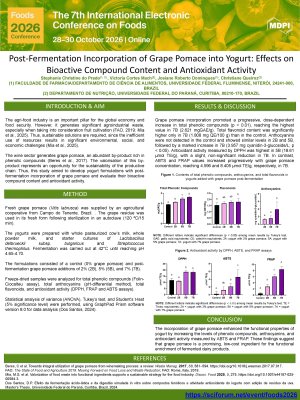
Fruit cultivation generates significant agroindustrial waste, requiring sustainable solutions. Grape pomace (GP), is an abundant by-product rich in dietary fiber and phenolic compounds. This study aimed to develop yogurt formulations with GP and evaluate their bioactive compound content and antioxidant activity. Fresh GP (Vitis labrusca) was supplied by an agricultural cooperative from Campo do Tenente, Brazil. Yogurts were prepared with whole pasteurized cow’s milk, whole powder milk, and starter cultures of Lactobacillus delbrueckii subsp. bulgaricus and Streptococcus thermophilus. Fermentation was carried out at 42°C until reaching pH 4.65-4.70. Formulations consisted of a control (0% GP) and post-fermentation GP additions of 2% (2B), 5% (5B), and 7% (7B). Freeze-dried samples were analyzed for total phenolic compounds (TPC, Folin-Ciocalteu assay), total anthocyanins (pH-differential method), total flavonoids, and antioxidant activity (DPPH, FRAP and ABTS assays). GP incorporation promoted a progressive, dose-dependent increase in TPC (p < 0.01), reaching the highest value in 7B (2.621 mgGAE/g). Total flavonoid content was significantly higher only in 7B (1.808 mg QE/100 g) than in the control. Anthocyanins were not detected in the control and showed similar levels in 2B and 5B, followed by a marked increase in 7B (3.957 mg cyanidin-3-glucoside/L; p < 0.05). Antioxidant activity measured by DPPH was highest in 5B (18.61 μmol TE/g), with a slight, non-significant reduction in 7B. In contrast, ABTS and FRAP values increased progressively with GP concentration, reaching 4.596 and 8.405 μmol TE/g, respectively, in 7B. The incorporation of grape pomace enhanced the functional properties of yogurt by increasing the levels of phenolic compounds, anthocyanins, and antioxidant activity measured by ABTS and FRAP. These findings suggest that grape pomace is a promising, low-cost ingredient for the functional enrichment of fermented dairy products.
Keywords
Agroindustrial waste
Functional Foods
Phenolic compounds
Poster
E-POSTER FOODS 2026.pdf
Development and Nutritional Characterization of Multispecies Seaweed Chips from Philippine Seaweeds
Characteristics of Latvian Red Wines Produced from Local Grape Varieties