Event submissions
Published
This submission belongs to the session C. Food Physicochemistry & Analysis of the event The 7th International Electronic Conference on Foods
Published date
23 Oct, 2026
Academic Editor
 Joana S. Amaral
Citation
Sintija Vetra, Artis Lusins, Zanda Kruma, Characteristics of Latvian Red Wines Produced from Local Grape Varieties, in Proceedings of The 7th International Electronic Conference on Foods, 28 October–30 October 2026, MDPI: Basel, Switzerland
Share
Email
Facebook
Twitter
LinkedIn
Characteristics of Latvian Red Wines Produced from Local Grape Varieties

Sintija Vetra 1
Artis Lusins 1
Zanda Kruma 1
1. Food Institute, Faculty of Agriculture and Food Technologies, Latvia University of Life Sciences and Technologies, Jelgava, Latvia
Abstract
Grape variety, fermentation conditions, and winemaking practices determine wine quality and its characteristics. Although wine production in Latvia has traditionally relied on berries and fruits, local climatic conditions also support the cultivation of grape varieties suitable for producing high-quality wines, thereby contributing to the development of the domestic wine industry.
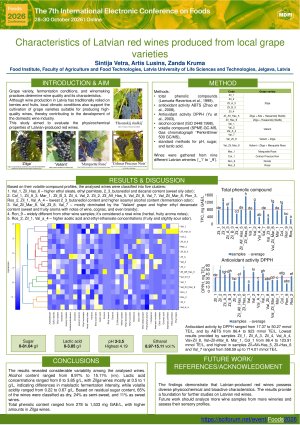
This study aimed to evaluate the physicochemical properties of Latvian-produced red wines. The volatile compound profile, phenolic content, antioxidant activity, and physicochemical characteristics of red wines produced primarily from the grape varieties Zilga, Valiant, and their blends were analysed. Physicochemical, spectrophotometric, and statistical methods were used to characterise wines from different Latvian wineries.
Statistically significant differences between the samples were determined using one-way analysis of variance (ANOVA) followed by Tukey’s test, with p ≤ 0.05 considered statistically significant. Hierarchical analysis and a heatmap were used to analyse the volatile compound data. Volatile aroma compounds were analysed by headspace solid-phase microextraction (HS-SPME) using a CAR/PDMS fibre, followed by GC–MS analysis (PerkinElmer Clarus 500) on a capillary column.
The results revealed considerable variability among the analysed wines. Alcohol content ranged from 8.97% to 15.11% (v/v). Lactic acid concentrations ranged from 0 to 3.85 g/L, with Zilga wines mostly at 0.5 to 1 g/L, indicating differences in malolactic fermentation intensity; while volatile acidity ranged from 0.22 to 0.67 g/L. Based on residual sugar content, 65% of the wines were classified as dry, 24% as semi-sweet, and 11% as sweet wines.
Volatile compound analysis revealed significant differences among samples. Total phenolic content ranged from 278 to 1,533 mg GAE/L, with higher amounts in Zilga wines. Antioxidant activity measured by DPPH ranged from 17.37 to 50.27 mmol TE/L and by ABTS from 86.4 to 923 mmol TE/L.
The findings demonstrate that Latvian-produced red wines possess diverse physicochemical and bioactive characteristics. The results provide a foundation for further studies on Latvian red wines.
Keywords
Latvian wines
red wine
phenolic compounds
antioxidant activity
‘Zilga’
‘Valiant’.
Poster
posteris_Vetra.pdf
Post-Fermentation Incorporation of Grape Pomace into Yogurt: Effects on Bioactive Compound Content and Antioxidant Activity
Thermomechanical Properties of Durum Wheat Semolina Blends Enriched with Pumpkin Flesh and Peel Flour Evaluated by Mixolab