Event submissions
Published
This submission belongs to the session C. Food Physicochemistry & Analysis of the event The 7th International Electronic Conference on Foods
Published date
23 Oct, 2026
Academic Editor
 Joana S. Amaral
Citation
Besar Jumniu, Ewa Pejcz, Agata Wojciechowicz, Durim Alija, Gafur Xhabiri, Joanna Harasym, Bean Pre-treatment Shapes the Techno-functional and Rheological-Pasting Behaviour of Wheat-Bean Flour Systems, in Proceedings of The 7th International Electronic Conference on Foods, 28 October–30 October 2026, MDPI: Basel, Switzerland
Share
Email
Facebook
Twitter
LinkedIn
Bean Pre-treatment Shapes the Techno-functional and Rheological-Pasting Behaviour of Wheat-Bean Flour Systems

Besar Jumniu 1
Ewa Pejcz 2
Agata Wojciechowicz 2
Durim Alija 1
Gafur Xhabiri 1

Joanna Harasym 2
1. Faculty of Food Technology and Nutrition, University of Tetova, Str. Ilinden, nn 1200 Tetova, North Macedonia
2. Department of Biotechnology and Food Analysis, Wroclaw University of Economics and Business, 53-345 Wrocław, Poland
Abstract
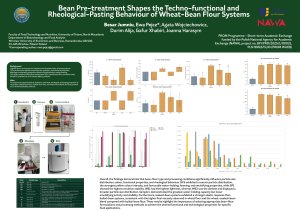
Introduction: Legume flours can improve the nutritional and functional value of cereal products, but their incorporation into wheat matrices depends on particle size, hydration and interfacial properties, and rheological-pasting behaviour. This study compared wheat flour, flours prepared from boiled and soaked beans, and wheat-bean blends as model systems for fermented bakery applications.
Methods: Samples were characterized for particle size distribution, CIE L*a*b* colour, techno-functional properties, foaming and emulsifying behaviour, oscillatory rheology, and pasting characteristics using a Rapid Visco Analyser.
Results and Discussion: The studied systems differed clearly in particle size distribution. Soaked-bean flour contained the highest coarse fraction, with 38.31% retained on the 0.500 mm sieve, whereas boiled-bean flour was mainly retained on the 0.355 mm sieve and wheat flour on the 0.250 mm sieve. Bean pre-treatment also affected colour: the wheat-boiled bean blend showed the highest lightness, while the wheat-soaked bean blend was the darkest and shifted towards positive a* values. The incorporation of bean flour modified functional behaviour, particularly interfacial properties. Bean flours and blends showed higher emulsifying activity than wheat flour, with values of approximately 14.2-15.8 compared with 4.18 for wheat flour. Oscillatory rheology indicated a stronger elastic response in soaked-bean systems than in boiled-bean systems. This tendency was consistent with the pasting profiles. Boiled-bean flour showed the lowest final viscosity, 632.75 mPa·s, while wheat flour and the wheat-soaked bean blend maintained much higher values, 2388.75 and 2282.50 mPa·s, respectively.
Conclusions: Bean pre-treatment strongly shaped the functional and rheological-pasting behaviour of wheat-bean flour systems. Soaked-bean flour promoted stronger structure formation and maintained paste-building capacity in blends, whereas boiled-bean flour markedly reduced final viscosity. These differences show that wheat-bean systems can be tailored by selecting the bean-flour variant according to the desired colour, interfacial functionality and viscosity profile.
Keywords
bean flour
wheat-bean blends
technofunctional properties
rheological properties
pasting properties
flour systems
Poster
Bean Pre-treatment Shapes the Techno-functional and Rheological-Pasting Behaviour of Wheat-Bean Flour Systems.pdf
Thermomechanical Properties of Durum Wheat Semolina Blends Enriched with Pumpkin Flesh and Peel Flour Evaluated by Mixolab
Comparative evaluation of quality characteristics and mineral profile of three avocado (Persea americana L.) culivars commercialized in Portugal: Fuerte, Hass and Ryan