Event submissions
Published
This submission belongs to the session B. Nutritional & Functional Foods of the event The 7th International Electronic Conference on Foods
Published date
23 Oct, 2026
Academic Editor
 Manuel Viuda-Martos
Citation
Carolina ARANIBAR, Silvina MERILES, Manuel LOBO, Rafael BORNEO, María Cecilia Penci, Pablo Daniel Ribotta, From the Andean Grain to the Functional Ingredient: Thermomechanical Extrusion of Amaranth for High-Value Food Applications, in Proceedings of The 7th International Electronic Conference on Foods, 28 October–30 October 2026, MDPI: Basel, Switzerland
Share
Email
Facebook
Twitter
LinkedIn
From the Andean Grain to the Functional Ingredient: Thermomechanical Extrusion of Amaranth for High-Value Food Applications

Carolina ARANIBAR 1
Silvina MERILES 2
Manuel LOBO 2
Rafael BORNEO 1
María Cecilia Penci 1

Pablo Daniel Ribotta 3
1. Instituto de Ciencia y Tecnología de los Alimentos (ICyTAC-UNC-CONICET), Córdoba, Argentina
2. Centro Interdisciplinario de Investigaciones en Tecnologías y Desarrollo Social para el NOA (CIITED-UNJU -CONICET), San Salvador de Jujuy, Jujuy, Argentina
3. Facultad de Ciencias Exactas, Físicas y Naturales - UNIVERSIDAD NACIONAL DE CÓRDOBA, Córdoba, Argentina
Abstract
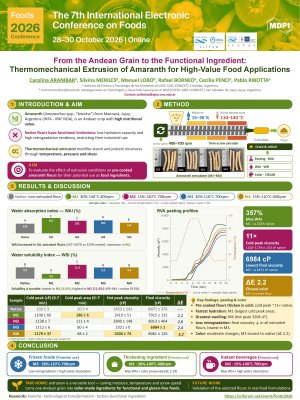
Amaranth (Amaranthus spp.) is an Andean crop with high nutritional value, however, native flours present some functional limitations, such as low hydration capacity and high retrogradation tendency. Thermomechanical extrusion enables modification of starch and protein structures through temperature, pressure, and shear, improving physic-chemical properties. This study evaluated the effect of extrusion conditions on pre-cooked amaranth flours for potential use as food ingredients. A twin-screw extruder was used at varying temperature (110–140°C), moisture (15–30%), and screw speed (400–700 rpm). Extrudates were dried, milled, and characterized for pasting properties (RVA), water absorption (WAI) and solubility (WSI) index, and color (CIELAB). Extrusion significantly increased WAI in all samples versus native flour (225%), reaching a maximum at 30%H-140°C-400rpm (357%). It also showed the lowest WSI (4.0%), while native flour had 9.3%. Conversely, 15%H-140°C-700rpm yielded the highest WSI (11.4%). RVA profiles revealed that extruded flours developed substantially higher cold peak viscosities (1100–1179 cP) than native flour (103 cP), indicating faster hydration. Hot peak viscosity ranged from 2321 to 3204 cP, with 15%-110°C-400rpm retaining the greatest swelling capacity. Final viscosity decreased in all extruded samples, with the lowest final viscosity observed for 30%-110°C-700rpm (6984 cP), reflecting reduced starch reorganization during cooling. Color differences relative to native flour were moderate, with 30%-140°C-400rpm showing the closest match (ΔE=2.19). In conclusion, extrusion proved a versatile tool for enhancing amaranth functionality. The 30%-110°C-700rpm condition combined low retrogradation with high water absorption, suggesting potential for use in frozen foods. The 30%-140°C-400rpm maximized WAI and preserved color, indicating potential as a thickening ingredient. The 15%-140°C-700rpm maximized the WSI while maintaining a high WAI, suggesting suitability for instant beverage formulation. Extruded amaranth flours exhibited enhanced techno-functional properties, positioning them as promising ingredients for functional and gluten-free food formulations.
Keywords
kiwicha
technological transformation
techno-functional ingredient
Poster
Poster_Foods2026_Aranibar_vfinal.pdf
Study on plastic pollution in some Bulgarian agricultural soils
Shelf-life dynamics of plain and lemon-flavored goat’s milk kefir