Event submissions
Published
This submission belongs to the session G. Food Safety, Toxicology & Quality of the event The 7th International Electronic Conference on Foods
Published date
23 Oct, 2026
Academic Editor
 Esther Sendra
Citation
Mariem Ayed, Sana Yakoubi, Vasco Cadavez, Ursula Gonzales-Barron, Shelf-life dynamics of plain and lemon-flavored goat’s milk kefir, in Proceedings of The 7th International Electronic Conference on Foods, 28 October–30 October 2026, MDPI: Basel, Switzerland
Share
Email
Facebook
Twitter
LinkedIn
Shelf-life dynamics of plain and lemon-flavored goat’s milk kefir

Mariem Ayed 1
Sana Yakoubi 2
Vasco Cadavez 1

Ursula Gonzales-Barron 1
1. CIMO Mountain Research Centre, School of Agriculture (ESA), Polytechnic Institute of Bragança, Bragança, Portugal
2. National Institute of Research and Physical-Chemical Analysis (INRAP), Laboratory of Materials, Treatment and
Analysis, Biotechpole Sidi-Thabet, 2020, Ariana, Tunisia
Abstract
Interest in probiotic foods has surged globally, with Europe’s market reaching approximately USD 14 billion in 2025, driven primarily by fermented dairy products like yogurt and kefir. Kefir is a probiotic beverage produced through combined lactic acid and alcoholic fermentation of animal or plant milks. Goat’s milk kefir is especially valued for its high nutritional quality and excellent digestibility.
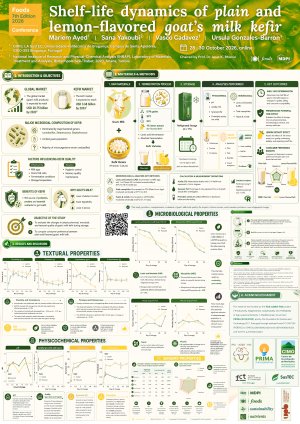
This study evaluated the physicochemical, microbiological, and textural characteristics of goat’s milk kefir during refrigerated storage, comparing plain and lemon-flavored varieties and assessing consumer preferences. Two kefir types were produced: a plain control and a lemon-flavored kefir with 1% lemon extract added before fermentation. Fermentation occurred at 20 °C for 24 h using a 0.9% grains-to-milk ratio, followed by storage at 4 °C. Over 13 days, pH, acidity, syneresis, proteolysis, firmness, viscosity, consistency, and microbial counts were monitored. Sensory evaluation was performed on samples stored up to 2 days. Data were analyzed using linear models and variance analysis, with graphs generated in R.
Lemon-flavored kefir maintained a lower pH, creating a less favorable environment for pathogens, reducing proteolysis, and improving textural stability. Both formulations exhibited similar firmness and cohesiveness, but lemon-flavored kefir showed higher viscosity and consistency, providing better mouthfeel and greater consumer acceptability. Microbiological analysis revealed slightly higher lactic acid bacteria and mesophile counts in plain kefir, though both remained within desirable probiotic ranges. Sensory results confirmed a significant preference for lemon-flavored kefir (p<0.05).
Overall, Lemon-flavored goat’s milk kefir showed favorable sensory attributes along with stable physicochemical and microbiological quality over 13 days of refrigerated storage. These results highlight its potential as a value-added probiotic dairy product and a promising candidate for industrial optimization and commercial development targeting health-conscious consumers.
Keywords
Goat’s milk kefir
shelf-life
linear modeling
physicochemical characteristics
microbiological quality
textural properties
sensory evaluation
lemon-flavored kefir
plain kefir
refrigerated storage
Poster
Poster MDPI.pdf
From the Andean Grain to the Functional Ingredient: Thermomechanical Extrusion of Amaranth for High-Value Food Applications
Comparative network pharmacology analysis of marker bioactive compounds from Greek monofloral honeys reveals potential anticancer-related mechanisms