Event submissions
Published
This submission belongs to the session B. Nutritional & Functional Foods of the event The 7th International Electronic Conference on Foods
Published date
23 Oct, 2026
Academic Editor
 Manuel Viuda-Martos
Citation
Achilleas Atzemopoulos, Eleftherios Alissandrakis, Alexandros G. Georgakilas, Comparative network pharmacology analysis of marker bioactive compounds from Greek monofloral honeys reveals potential anticancer-related mechanisms, in Proceedings of The 7th International Electronic Conference on Foods, 28 October–30 October 2026, MDPI: Basel, Switzerland
Share
Email
Facebook
Twitter
LinkedIn
Comparative network pharmacology analysis of marker bioactive compounds from Greek monofloral honeys reveals potential anticancer-related mechanisms

Achilleas Atzemopoulos 1

Eleftherios Alissandrakis 2

Alexandros G. Georgakilas 3
1. School of Science and Technology, Hellenic Open University, Patras 26335, Greece
2. Department of Agriculture, School of Agricultural Sciences, Hellenic Mediterranean University, P.O. Box 1939, GR 71410 Heraklion, Greece
3. DNA Damage Laboratory, Physics Department, School of Applied Mathematical and Physical Sciences, National Technical
University of Athens, 157 80 Athens, Greece
Abstract
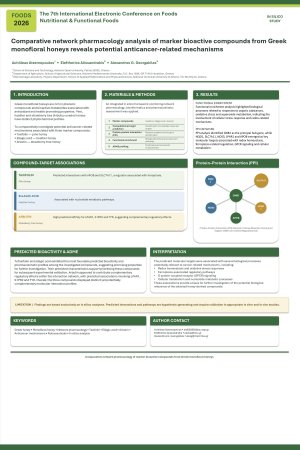
Greek monofloral honeys constitute a rich source of phenolic compounds and bioactive metabolites with documented antioxidant and health-promoting properties. Among them, pine, heather and strawberry tree (Arbutus unedo) honeys are characterized by distinct phytochemical profiles and considerable biological interest. The present study aimed to comparatively investigate the potential anticancer-related activity of three representative marker compounds associated with these honey varieties: taxifolin (pine honey), ellagic acid (heather honey) and arbutin (strawberry tree honey). An integrated in silico framework combining network pharmacology, bioinformatics and pharmacokinetic assessment was employed to identify molecular targets and characterize biologically relevant pathways. Computational target prediction, protein–protein interaction (PPI) network analysis, functional enrichment analysis and ADME profiling were applied to evaluate the biological relevance and pharmacological potential of the selected compounds. Functional enrichment analysis identified significant biological processes associated with the response to organic substances oxidative stress and superoxide metabolism. PPI network analysis identified GNB1 as the principal hub gene, while NQO1, SLC7A11, NOS3, LPAR1 and APOB emerged as key molecular targets involved in redox homeostasis, ferroptosis, GPCR-mediated signaling and cellular metabolism. Taxifolin was predicted to interact with APOB and the ferroptosis regulator SLC7A11, ellagic acid was associated with nucleotide metabolic pathways, whereas arbutin showed high predicted affinity for LPAR1, S1PR2 and TYR, suggesting complementary regulatory mechanisms. Among the investigated compounds, taxifolin and ellagic acid demonstrated the most favorable predicted bioactivity and pharmacokinetic characteristics, whereas arbutin appeared to exert complementary regulatory effects within the interaction network. Overall, these computational findings suggest that bioactive compounds from Greek monofloral honeys may influence multiple cancer-related molecular pathways through a multitarget mechanism. However, these predictions are based exclusively on in silico analyses and should be considered hypothesis-generating until confirmed by appropriate in vitro and in vivo studies.
Keywords
Greek honey
monofloral honey
network pharmacology
bioactive compounds
taxifolin
ellagic acid
arbutin
anticancer mechanisms
nutraceuticals
in silico analysis
Poster
Greek_Honey_Network_Pharmacology_Poster_Revised.pdf
Shelf-life dynamics of plain and lemon-flavored goat’s milk kefir
Supporting Allergen Risk Management in Spice Supply Chains: Detection of Peanut Contamination in Garlic and Garlic-Derived Products Using Molecular and Protein-Based Approaches