Event submissions
Published
This submission belongs to the session G. Food Safety, Toxicology & Quality of the event The 7th International Electronic Conference on Foods
Published date
23 Oct, 2026
Academic Editor
 Esther Sendra
Citation
Bashar Hamadalla, Joji Komazaki, Alexandra Davis, Tiziana Sgamma, Supporting Allergen Risk Management in Spice Supply Chains: Detection of Peanut Contamination in Garlic and Garlic-Derived Products Using Molecular and Protein-Based Approaches, in Proceedings of The 7th International Electronic Conference on Foods, 28 October–30 October 2026, MDPI: Basel, Switzerland
Share
Email
Facebook
Twitter
LinkedIn
Supporting Allergen Risk Management in Spice Supply Chains: Detection of Peanut Contamination in Garlic and Garlic-Derived Products Using Molecular and Protein-Based Approaches

Bashar Hamadalla 1
Joji Komazaki 1
Alexandra Davis 1
Tiziana Sgamma 1
1. Leicester School of Allied Health Sciences, De Montfort University, Leicester, LE1 9BH, UK.
Abstract
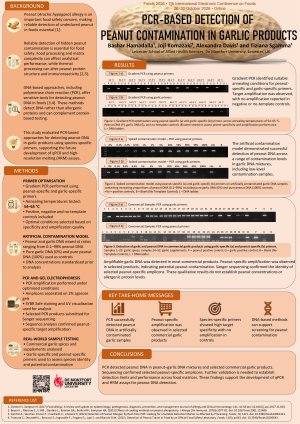
Introduction: Peanut (Arachis hypogaea) allergy is one of the leading causes of severe food-induced allergic reactions worldwide. Effective allergen management requires reliable methods for detecting unintended peanut contamination in food products. While protein-based methods such as enzyme-linked immunosorbent assays (ELISA) are widely used, their performance can be influenced by food processing and matrix complexity. DNA-based approaches, building on advances in molecular species authentication and DNA barcoding, offer a complementary strategy owing to the stability and specificity of nucleic acid targets.
Methods: Artificially contaminated garlic samples, commercial garlic products, and garlic-derived supplements were analysed using conventional polymerase chain reaction (PCR), quantitative PCR (qPCR), high-resolution melting (HRM) analysis, and ELISA. A peanut-specific molecular marker was evaluated alongside ELISA to compare the analytical performance, sensitivity, and suitability of DNA-based and protein-based approaches across different contamination levels and garlic-based matrices.
Results and Discussion: Peanut DNA was successfully detected in artificially contaminated samples and in selected commercial garlic products and garlic-derived supplements using DNA-based approaches. ELISA analysis was also successfully completed for the same sample set. No amplification was observed in uncontaminated controls, demonstrating assay specificity. Comparative analyses are ongoing to evaluate the relative analytical sensitivity and practical performance of PCR, qPCR, HRM analysis, and ELISA across different contamination levels and garlic-based matrices.
Conclusions: This research addresses the growing need for robust allergen monitoring tools within spice supply chains, where complex sourcing networks and processing practices can increase the risk of unintended cross-contamination. The study supports the development of evidence-based allergen detection strategies with the potential to strengthen food safety, quality assurance, traceability, and regulatory compliance within the spice sector.
Keywords
peanut allergy
allergen detection
molecular authentication
food safety
qPCR
high-resolution melting analysis
ELISA
spice supply chains
Poster
Sciforum-197500 Tiziana Sgamma poster.pdf
Comparative network pharmacology analysis of marker bioactive compounds from Greek monofloral honeys reveals potential anticancer-related mechanisms
Shelf-life evaluation of pasteurised Nocellara del Belice table olives produced by the Castelvetrano method