Event submissions
Published
This submission belongs to the session G. Food Safety, Toxicology & Quality of the event The 7th International Electronic Conference on Foods
Published date
23 Oct, 2026
Academic Editor
 Esther Sendra
Citation
Giulio Perricone, Davide Alongi, Carlotta Conigliaro, Vincenzo Naselli, Irene Dolce, Francesco La Croce, Giancarlo Moschetti, Nicola Francesca, Antonio Alfonzo, Shelf-life evaluation of pasteurised Nocellara del Belice table olives produced by the Castelvetrano method, in Proceedings of The 7th International Electronic Conference on Foods, 28 October–30 October 2026, MDPI: Basel, Switzerland
Share
Email
Facebook
Twitter
LinkedIn
Shelf-life evaluation of pasteurised Nocellara del Belice table olives produced by the Castelvetrano method

Giulio Perricone 1
Davide Alongi 1
Carlotta Conigliaro 1
Vincenzo Naselli 1
Irene Dolce 1
Francesco La Croce 2
Giancarlo Moschetti 1
Nicola Francesca 1

Antonio Alfonzo 1
1. Department of Agricultural, Food and Forest Sciences (SAAF), University of Palermo, Viale delle Scienze, Palermo, 90128, Italy
2. Geolive Belice S.r.l., S.S. 115 Km Dir, Marinella, Castelvetrano, 91022, Italy
Abstract
Introduction
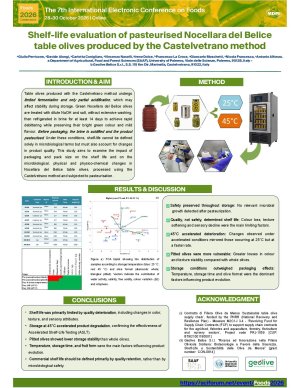
Table olives produced with the Castelvetrano method undergo limited fermentation and only partial acidification, which may affect stability during storage. Green Nocellara del Belice olives are treated with dilute NaOH and salt, without extensive washing, then refrigerated in brine for at least 14 days to achieve rapid debittering while preserving their bright green colour and mild flavour. Before packaging, the brine is acidified and the product pasteurised. Under these conditions, shelf-life cannot be defined solely in microbiological terms but must also account for changes in product quality.
Methods
Pasteurised Nocellara del Belice table olives (60–63 PU), whole or pitted, were packaged in five commercial formats — tin cans and four glass jars (314, 327, 580 and 1062 mL) — and stored at 25 °C or 45 °C for up to 180 days, with all analyses performed in triplicate. Microbiological analyses were conducted alongside measurements of pH, water activity, salinity and free acidity. Colour was assessed via CIELAB parameters and total colour difference (ΔE), and sensory properties were evaluated by a trained panel. Multivariate analysis (PCA and hierarchical clustering) was performed to explore relationships among variables.
Results and Discussion
No microbial growth was detected during storage, confirming the effectiveness of pasteurisation, although clear changes occurred in physicochemical and sensory attributes, especially at 45 °C. Crispness and flavour balance declined progressively, while colour changes were less pronounced but still temperature-dependent. Pitted olives lost quality faster than whole olives, indicating greater structural susceptibility. Multivariate analysis confirmed temperature as the primary driver of product evolution, with olive format playing a secondary role and packaging having comparatively little influence.
Conclusions
The shelf-life of pasteurised Castelvetrano table olives is thus driven primarily by quality degradation rather than microbiological instability, with temperature and product format as key factors in preserving product quality during storage.
Keywords
Table olives
Shelf-life
Castelvetrano method
Poster
Shelf-life evaluation_G. Perricone.pdf
Supporting Allergen Risk Management in Spice Supply Chains: Detection of Peanut Contamination in Garlic and Garlic-Derived Products Using Molecular and Protein-Based Approaches
Preharvest sorbitol–calcium treatment reduces chilling injury and postharvest losses in pomegranate cv. 'Mollar de Elche' stored at 2 °C and 7 °C