Event submissions
Published
This submission belongs to the session G. Food Safety, Toxicology & Quality of the event The 7th International Electronic Conference on Foods
Published date
23 Oct, 2026
Academic Editor
 Esther Sendra
Citation
Alberto Guirao, Ánder Solana-Guilabert, Fernando Garrido-Auñón, Huertas María Díaz-Mula, Juan Miguel Valverde, Domingo Martínez-Romero, Pre-harvest treatments with sorbitol and salicylic acid to preserve quality and reduce chilling injury in 'Sanguinelli' blood oranges during cold storage, in Proceedings of The 7th International Electronic Conference on Foods, 28 October–30 October 2026, MDPI: Basel, Switzerland
Share
Email
Facebook
Twitter
LinkedIn
Pre-harvest treatments with sorbitol and salicylic acid to preserve quality and reduce chilling injury in 'Sanguinelli' blood oranges during cold storage

Alberto Guirao 1

Ánder Solana-Guilabert 1
Fernando Garrido-Auñón 1

Huertas María Díaz-Mula 1

Juan Miguel Valverde 1

Domingo Martínez-Romero 1
1. University Institute for Agro-Food and Agro-Environmental Research and Innovation, Miguel Hernández University, Elche, Alicante, Spain
Abstract
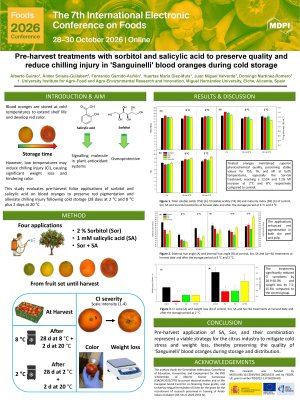
'Sanguinelli' blood oranges are highly valued for their characteristic flavour and red purplish colour. However, cold storage is required to extend shelf-life and boost red colour, which frequently induces chilling injury (CI), causing significant weight loss and hindering the red colouration. This study evaluates pre-harvest foliar sprays of 1 mM salicylic acid (SA), 2% sorbitol, and their combination (Sor+SA) applied from fruit set until harvest at intervals of 14 days for a total of 4 applications. SA is a key signal molecule that activates defence-related pathways, including reactive oxygen species scavenging and heat-shock protein induction, while sorbitol provides an osmoprotective function to preserve membrane integrity under cold stress.
After harvest, fruits were stored at 2°C and 8°C for 28 days, followed by 2 days at 20°C to simulate retail conditions. The treatments significantly reduced CI symptoms by 28.9-50.0% and weight loss by 7.3-15.6% compared to the control group. Furthermore, the applications enhanced red pigmentation in both the peel and pulp. While CI typically diminishes the anthocyanin pathways responsible for the fruit's characteristic colouration, the effects of SA and Sor+SA treatments mitigated this decline, resulting in an external and internal hue angle significant (p<0.05) decrease of 15.6-22.8 % respectively compared to control at 2°C. Sorbitol treatments could be reinforcing this effect by upregulating metabolic activity within the phenylpropanoid pathway. Treated oranges maintained superior physicochemical quality, preserving stable values for total soluble solids, titratable acidity, and the maturity index at both temperatures, especially the Sor+SA treatment, reaching a 12.0% and 7.1% MI increase (p<0.05) at 2°C and 8°C respectively compared to control. Pre-harvest application of SA, sorbitol, and their combination represent a viable strategy for the citrus industry to mitigate cold stress and weight loss, thereby preserving the quality of 'Sanguinelli' blood oranges during storage and distribution.
Keywords
Citrus sinensis
cold stress
treatments
colour
postharvest.
Poster
Guriao, A. Poster FOODS.pdf
Preharvest sorbitol–calcium treatment reduces chilling injury and postharvest losses in pomegranate cv. 'Mollar de Elche' stored at 2 °C and 7 °C
Development of a simultaneous voltammetric method for amaranth and tartrazine employing a glassy carbon electrode modified with graphene/carboxymethyl-botryosphaeran