Event submissions
Published
This submission belongs to the session G. Food Safety, Toxicology & Quality of the event The 7th International Electronic Conference on Foods
Published date
23 Oct, 2026
Academic Editor
 Esther Sendra
Citation
Gustavo Fix, Elen Romão Sartori, Development of a simultaneous voltammetric method for amaranth and tartrazine employing a glassy carbon electrode modified with graphene/carboxymethyl-botryosphaeran, in Proceedings of The 7th International Electronic Conference on Foods, 28 October–30 October 2026, MDPI: Basel, Switzerland
Share
Email
Facebook
Twitter
LinkedIn
Development of a simultaneous voltammetric method for amaranth and tartrazine employing a glassy carbon electrode modified with graphene/carboxymethyl-botryosphaeran

Gustavo Fix 1
Elen Romão Sartori 1
1. Laboratory of Electroanalytical and Sensors, Department of Chemistry, State University of Londrina, P.O. Box: 10.011, Londrina, Paraná, Brazil
Abstract
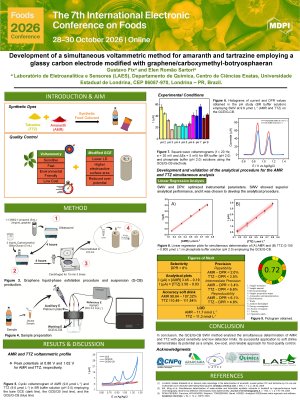
The synthetic dyes amaranth (AMR; Bordeaux Red S, INS 123) and tartrazine (TTZ; INS 102) are widely used in the food industry to provide attractive colors to foods and beverages. Due to regulations that establish maximum permitted concentrations of 10 mg/100 g for these additives in commercial products, reliable analytical methods are required for their determination and quality control. In this work, a voltammetric method was developed for the simultaneous determination of AMR and TTZ using a glassy carbon electrode modified with a suspension of graphene in carboxymethyl-botryosphaeran (GR-βG/GCE). Voltammetric measurements were performed using an Autolab PGSTAT 101 potentiostat/galvanostat connected to an electrochemical cell containing the GR-βG/GCE as the working electrode, an Ag/AgCl (3.0 mol L⁻¹ KCl) as reference electrode, and a platinum plate as the auxiliary electrode. AMR and TTZ presented well-defined oxidation peaks at 0.88 V and 1.10 V, respectively, allowing their simultaneous determination without peak overlapping. The supporting electrolyte selected for this determination was a phosphate buffer solution (pH = 2.0). The parameters of the SWV were optimized (f = 20 Hz, a = 30 mV and ΔEs = 5 mV) and used for constructing the analytical curves. The oxidation current was directly proportional to the concentration of AMR and TTZ from 336 to 805 nmol L⁻¹ and 336 to 805 nmol L⁻¹, respectively, with limit of detection of 11,7 nmol L⁻¹ and 11,3 nmol L⁻¹. The method was successfully applied to the determination of AMR and TTZ in soft drinks. The results demonstrate the applicability of the GR-βG/GCE for the simultaneous electrochemical determination of AMR and TTZ, providing a simple, sensitive, and low-cost analytical approach with potential application in food quality control.
Keywords
Quality Control
Synthetic Dyes
Voltammetry
Graphene.
Poster
Poster_Fix.pdf
Pre-harvest treatments with sorbitol and salicylic acid to preserve quality and reduce chilling injury in 'Sanguinelli' blood oranges during cold storage
Thermal Resistance of Selected Heat-Resistant Spore-Forming Bacteria in Philippine Shelf-Stable Foods at Different Syrup Concentrations