Event submissions
Published
This submission belongs to the session B. Nutritional & Functional Foods of the event The 7th International Electronic Conference on Foods
Published date
23 Oct, 2026
Academic Editor
 Manuel Viuda-Martos
Citation
Ana Divito, Roberta Ansorena, Cintia Mazzucotelli, Christian Rodríguez Rodrigues, Pilar Buera, Karina Di Scala, Food microstructure as a modulator of the bioaccessibility and anti-inflammatory activity of bioactive compounds in pumpkin snacks enriched with thyme essential oil, in Proceedings of The 7th International Electronic Conference on Foods, 28 October–30 October 2026, MDPI: Basel, Switzerland
Share
Email
Facebook
Twitter
LinkedIn
Food microstructure as a modulator of the bioaccessibility and anti-inflammatory activity of bioactive compounds in pumpkin snacks enriched with thyme essential oil

Ana Divito 1,2,3
Roberta Ansorena 1,2
Cintia Mazzucotelli 1
Christian Rodríguez Rodrigues 2,4
Pilar Buera 2,4,5
Karina Di Scala 1,2
1. Research Group in Food Engineering (GIIA), Institute of Food Science, Technology and Environment (INCITAA), Faculty of Engineering, National University of Mar del Plata, Mar del Plata, B7608FBQ, Buenos Aires, Argentina
2. National Scientific and Technical Research Council (CONICET), Buenos Aires, C1425FQB, Argentina
3. Faculty of Exact and Natural Sciences, University of Buenos Aires, Buenos Aires, C1428EGA, Argentina
4. Department of Chemistry, Faculty of Exact and Natural Sciences, National University of Mar del Plata, Mar del Plata, 7600, Buenos Aires, Argentina
5. Institute of Food Technology and Chemical Processes (ITAPROQ), CONICET–University of Buenos Aires, Buenos Aires, C1428EGA, Argentina
Abstract
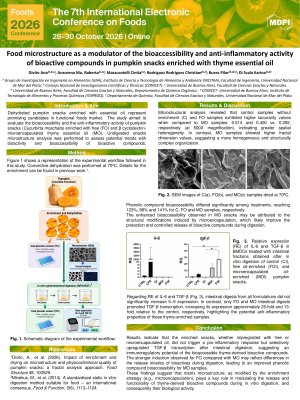
Pumpkin snacks enriched with essential oil represent promising candidates in functional foods market. The present study evaluated the bioaccessibility and anti-inflammatory activity of pumpkin snacks (Cucurbirta moschata) enriched with free (FO) and β-cyclodextrin-microencapsulated thyme essential oil (MO). Undigested snacks microstructure analysis was also performed to assess potential trends with bioactivity and bioaccessibility of bioactive compounds. Samples were subjected to an in vitro gastrointestinal digestion model (INFOGEST). Total phenolic content was determined by the Folin–Ciocalteu assay in the undigested snacks and in the gastric and intestinal digesta. The expression of IL-6 and TGF-β in the intestinal digesta was determined by RT-qPCR. The microstructure of the undigested snacks was characterized by scanning electron microscopy (SEM). Fractal dimension and lacunarity were determined from SEM images using ImageJ. Microstructural analysis showed higher lacunarity in control (C) and FO samples than in MO samples (0.514 and 0.400 vs. 0.292, respectively, at 500X magnification), indicating greater spatial heterogeneity. In contrast, MO exhibited a higher fractal dimension, reflecting a more homogeneous and structurally complex organization. Phenolic compound bioaccessibility differed significantly among treatments, reaching 141% for MO samples. The enhanced bioaccessibility observed in MO snacks may be associated with the structural modifications induced by microencapsulation, which could influence the release and protection of bioactive compounds during digestion. Intestinal digests from all formulations did not significantly increase IL-6 expression. Conversely, only FO and MO intestinal digests promoted TGF-β transcription, increasing its expression approximately 25-fold and 13-fold relative to the control, respectively, highlighting the potential anti-inflammatory properties of these thyme-enriched samples. The results demonstrate that microencapsulation improved phenolic compound bioaccessibility, while both free and microencapsulated thyme essential oil exhibited biological activity after digestion. Overall, the findings suggest that food matrix microstructure and microencapsulation play an important role in modulating the release and functionality of thyme-derived bioactive compounds during digestion.
Keywords
anti-inflammatory activity
pumpkin snack
microstructure
fracatal analysis
Poster
Foods poster - Divito.pdf
Thermal Resistance of Selected Heat-Resistant Spore-Forming Bacteria in Philippine Shelf-Stable Foods at Different Syrup Concentrations
Postharvest Quality Changes and Thermal Injury Development in Hot Water-Treated Philippine Carabao Mangoes (Mangifera indica L.) During Ripening