Event submissions
Published
This submission belongs to the session G. Food Safety, Toxicology & Quality of the event The 7th International Electronic Conference on Foods
Published date
23 Oct, 2026
Academic Editor
 Esther Sendra
Citation
Ezra Gabrielle J. Cacayan, Guiller Dartin L. Canapi, Gina B. Abrera, Ma. Patricia V. Azanza, Custer C. Deocaris, Gerieka R. Anapi, Postharvest Quality Changes and Thermal Injury Development in Hot Water-Treated Philippine Carabao Mangoes (Mangifera indica L.) During Ripening, in Proceedings of The 7th International Electronic Conference on Foods, 28 October–30 October 2026, MDPI: Basel, Switzerland
Share
Email
Facebook
Twitter
LinkedIn
Postharvest Quality Changes and Thermal Injury Development in Hot Water-Treated Philippine Carabao Mangoes (Mangifera indica L.) During Ripening

Ezra Gabrielle J. Cacayan 1
Guiller Dartin L. Canapi 1
Gina B. Abrera 1
Ma. Patricia V. Azanza 2
Custer C. Deocaris 1

Gerieka R. Anapi 2
1. Biomedical Research Section, Atomic Research Division, Philippine Nuclear Research Institute, Department of Science and Technology, Quezon City, Philippines
2. Department of Food Science and Nutrition, College of Home Economics, University of the Philippines Diliman, Quezon City, Philippines
Abstract
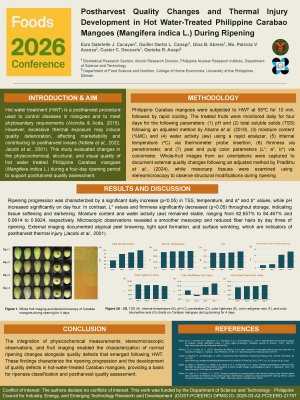
Hot water treatment (HWT) is a postharvest procedure used to control diseases in mangoes and to meet phytosanitary requirements. However, excessive thermal exposure may induce quality deterioration, affecting marketability and contributing to postharvest losses. This study evaluated changes in the physicochemical, structural, and visual quality of hot water-treated Philippine Carabao mangoes (Mangifera indica L. cv. Carabao) during a four-day ripening period to support postharvest quality assessment. Philippine Carabao mangoes were subjected to HWT at 55ºC for 10 min, followed by rapid cooling. The treated fruits were monitored daily for four days for pH, total soluble solids (TSS), moisture content (% (MC), water activity (aw), internal temperature, firmness, and peel and pulp color parameters (L*, a*, b*). Whole-fruit images from six orientations were captured to document external quality changes, while mesocarp tissues were examined using stereomicroscopy to observe structural modifications during ripening. Ripening progression was characterized by a significant daily increase (p<0.05) in TSS, temperature, and a* and b* values, while pH increased significantly on day four. In contrast, L* values and firmness significantly decreased (p<0.05) throughout storage, indicating tissue softening and darkening. Moisture content and water activity (aw) remained stable, ranging from 82.657% to 84.467% and 0.9814 to 0.9924, respectively. Microscopic observations revealed a smoother mesocarp and reduced fiber hairs by day three of ripening. External imaging documented atypical peel browning, light spot formation, and surface wrinkling, which are indicators of postharvest thermal injury. The integration of physicochemical measurements, stereomicroscopic observations, and fruit imaging enabled the characterization of normal ripening changes alongside quality defects that emerged following HWT. These findings characterize the ripening progression and the development of quality defects in hot-water-treated Carabao mangoes, providing a basis for ripeness classification and postharvest quality assessment.
Keywords
Philippine Carabao mango (Mangifera indica L.)
postharvest quality
ripening
hot water treatment
thermal injury
Poster
Foods 2026_Cacayan et al.pdf
Food microstructure as a modulator of the bioaccessibility and anti-inflammatory activity of bioactive compounds in pumpkin snacks enriched with thyme essential oil
Oil yield, fatty acid profile, and nutraceutical potential of Nigella damascena seeds under varying pedoclimatic conditions