Event submissions
Published
This submission belongs to the session C. Food Physicochemistry & Analysis of the event The 7th International Electronic Conference on Foods
Published date
23 Oct, 2026
Academic Editor
 Joana S. Amaral
Citation
Cristian-Adrian Savu, Valentin-Cristian Adam, Andrei-Gabriel Usuc, Raluca-Alice Băltăreţu, Alexandru Cîrîc, Nicoleta-Aurelia Chira, Oil yield, fatty acid profile, and nutraceutical potential of Nigella damascena seeds under varying pedoclimatic conditions, in Proceedings of The 7th International Electronic Conference on Foods, 28 October–30 October 2026, MDPI: Basel, Switzerland
Share
Email
Facebook
Twitter
LinkedIn
Oil yield, fatty acid profile, and nutraceutical potential of Nigella damascena seeds under varying pedoclimatic conditions

Cristian-Adrian Savu 1,2
Valentin-Cristian Adam 1
Andrei-Gabriel Usuc 1
Raluca-Alice Băltăreţu 2,3
Alexandru Cîrîc 4,5
Nicoleta-Aurelia Chira 1
1. "C. Nenitescu" Department of Organic Chemistry, Faculty of Chemical Engineering and Biotechnologies, National University of Science and Technology POLITEHNICA Bucharest, Bucharest, Romania
2. Chemistry Department, ICA Research & Development, 202 Splaiul Independentei, sector 6, Bucharest, Romania
3. Science and Engineering of Oxide Materials and Nanomaterials Department, Faculty of Chemical Engineering and Biotechnology, National University of Science and Technology POLITEHNICA Bucharest, 1-7 Gh. Polizu Street, 011061 Bucharest, Romania
4. Department of Biotechnical Systems, Faculty of Biotechnical Systems Engineering, National University of Science and Technology POLITEHNICA Bucharest, 313 Spl. Independentei, sector 6, postal code 060042, Bucharest, Romania
5. ICA Research & Development, 202 Splaiul Independentei, sector 6, Bucharest, Romania
Abstract
Background: Nigella damascena, an annual species of the Ranunculaceae family, is increasingly considered a promising source of specialty vegetable oil and bioactive lipids for functional food applications. Seed and oil yields, together with the fatty acid profile (FAP) and nutraceutical quality of the oil, can vary substantially in response to pedoclimatic conditions across growing seasons.
Objective: This study aims to quantify seed and oil yield of Nigella damascena over multiple years, to characterize the FAP and nutraceutical indices of its seed oil, and to evaluate how pedoclimatic conditions influence plant development and oil production.
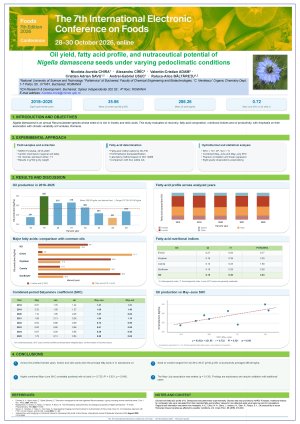
Methods: Nigella damascena was cultivated at INCDA Fundulea between 2018-2025. Seed lipid content (32.39-39.27 g oil/100 g dry seeds) and seed yield were determined and combined to obtain oil yield per hectare (237.28-351.86 kg/ha). FAP was established by GC-MS, and standard nutraceutical indices were calculated. A multiple linear regression model used monthly Selyaninov hydrothermal coefficients to assess the impact of temperature-precipitation patterns on oil yield.
Results: FAP was dominated by unsaturated fatty acids, mainly linoleic and oleic acids, with saturated palmitic and stearic acids contributing the remainder, yielding PUFA/SFA ratios >1 and acceptable atherogenic and thrombogenic indices, confirming a high proportion of unsaturated lipids. Oil yield varied considerably among years, from 237.28 kg/ha (2024) to 351.86 kg/ha (2019). The regression model indicated that Selyaninov coefficients for March, May and June had statistically significant effects (p<0.05) on oil yield, with March exerting a negative influence and May-June a positive one.
Conclusions: The study demonstrates that both the quantitative performance and nutraceutical quality of Nigella damascena seed oil depend strongly on pedoclimatic variability during the growing season. These findings support the potential of Nigella damascena as a functional oilseed crop and highlight the value of hydrothermal indices as tools for predicting oil yield under changing climatic conditions.
Keywords
Nigella damascena
seed oil
fatty acid profile
nutraceutical indices
oil yield
pedoclimatic conditions
Selyaninov hydrothermal coefficient
multiple linear regression
Poster
Sciforum-198362_2026_Cristian Savu.pdf
Postharvest Quality Changes and Thermal Injury Development in Hot Water-Treated Philippine Carabao Mangoes (Mangifera indica L.) During Ripening
Exploring the Antioxidant Capacity of Lupin Flour as a Sustainable Functional Ingredient