Event submissions
Published
This submission belongs to the session C. Food Physicochemistry & Analysis of the event The 7th International Electronic Conference on Foods
Published date
23 Oct, 2026
Academic Editor
 Joana S. Amaral
Citation
Matilde Maia, Patrícia Matos, Ana Teresa Sanches, Fernando Ramos, Exploring the Antioxidant Capacity of Lupin Flour as a Sustainable Functional Ingredient, in Proceedings of The 7th International Electronic Conference on Foods, 28 October–30 October 2026, MDPI: Basel, Switzerland
Share
Email
Facebook
Twitter
LinkedIn
Exploring the Antioxidant Capacity of Lupin Flour as a Sustainable Functional Ingredient

Matilde Maia 1
Patrícia Matos 1,2,3

Ana Teresa Sanches 1,4,5

Fernando Ramos 1,2
1. University of Coimbra, Faculty of Pharmacy, Polo III, Azinhaga de St, Comba, 3000-548 Coimbra, Portugal
2. LAQV, REQUIMTE, Laboratory of Bromatology and Pharmacognosy, Faculty of Pharmacy, University of Coimbra, Polo III, Azinhaga de Sta Comba, 3000-548, Coimbra, Portugal
3. Chemical Engineering and Renewable Resources for Sustainability (CERES), University of Coimbra, Rua Sílvio Lima, 3030-790 Coimbra, Portugal
4. Centre for the Study in Animal Science, Medical and Biomedical Sciences School, Fernando Pessoa University, Gondomar, Portugal
5. Associate Laboratory for Animal and Veterinary Sciences (Al4AnimalS), 1300-477 Lisbon, Portugal
Abstract
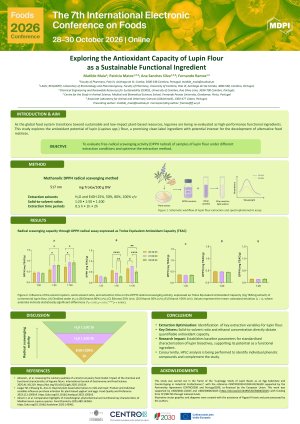
Introduction: As the global food system transitions toward sustainable and low-impact plant-based resources, legumes are being re-evaluated as high-performance functional ingredients. This study explores the antioxidant potential of lupin (Lupinus spp.) flour, a promising clean-label ingredient with potential interest for the development of alternative food matrices [1,2].
Methods: The free radical scavenging activity of lupin extracts was evaluated utilising an adapted DPPH (2,2-diphenyl-1-picrylhydrazyl) radical scavenging assay [3] under various solid-to-solvent ratios and ethanol concentrations (25%, 50%, 80%, and 100% v/v), alongside an aqueous extraction (H2O), all maintained at room temperature for 5 h under constant agitation.
Results: The antioxidant activity, expressed as Trolox Equivalent Antioxidant Capacity (TEAC), demonstrated distinct variation across the alcoholic extracts. The highest antioxidant capacity was achieved with the EtOH 80% 1:100 condition (87 mg Trolox/100 g DW), followed by EtOH 80% 1:50 (61 mg Trolox/100 g DW), while the lowest among quantifiable matrices were observed in EtOH 80% 1:20 (35 mg Trolox/100 g DW).
Conclusion: This study successfully optimises key extraction variables, demonstrating that the solid-to-solvent ratio and ethanol concentration directly influence the quantifiable antioxidant capacity of lupin flour. These baseline parameters provide crucial data for the standardised characterisation of lupin bioactive compounds, supporting its potential future exploration as a functional ingredient.
References:
[1]Akissoé L, et al. Assessing the culinary qualities of a shortcrust pastry food model: Impact of the chemical and functional characteristics of legume flours. International Journal of Gastronomy and Food Science 2025;41:101219. https://doi.org/10.1016/j.ijgfs.2025.101219.
[2]Jaeger SR, Chheang SL, Ares G. Beyond plant-based alternatives to milk and meat: Product and individual variables influence purchase intention for plant-based yoghurt and eggs. Food Quality and Preference 2023;112:105019. https://doi.org/10.1016/j.foodqual.2023.105019.
[3] Akremi I, et al. Comparative highlights of morphological, phytochemical and nutritional key characteristics of Mediterranean Lupinus species. Food Chemistry 2025;480:143962. https://doi.org/10.1016/j.foodchem.2025.143962.
Keywords
Keywords: Sustainability
Lupin Flour
Antioxidant Capacity
DPPH
Food Matrices
Poster
Foods poster_MatildeMaia.pdf
Oil yield, fatty acid profile, and nutraceutical potential of Nigella damascena seeds under varying pedoclimatic conditions
What's beyond macro- and micro-nutrients? NMR metabolite profiling of edible insects for a larger view of their features