Event submissions
Published
This submission belongs to the session C. Food Physicochemistry & Analysis of the event The 7th International Electronic Conference on Foods
Published date
23 Oct, 2026
Academic Editor
 Joana S. Amaral
Citation
Johnny Fernando Granja Travez, Ander Solana-Guilabert, Alberto Guirao Carrascosa, Domingo Jesus Martinez Romero, Juan Miguel Valverde Veracruz, Metabolic Changes during Coffee Cherry Ripening and Their Implications for Coffee Processing, in Proceedings of The 7th International Electronic Conference on Foods, 28 October–30 October 2026, MDPI: Basel, Switzerland
Share
Email
Facebook
Twitter
LinkedIn
Metabolic Changes during Coffee Cherry Ripening and Their Implications for Coffee Processing

Johnny Fernando Granja Travez 1,2
Ander Solana-Guilabert 2
Alberto Guirao Carrascosa 2

Domingo Jesus Martinez Romero 2

Juan Miguel Valverde Veracruz 2
1. Faculty of Agricultural and Renewable Natural Resources, Universidad Nacional de Loja, Loja, Ecuador
2. Department of Agro-Food Technology, Miguel Hernández University of Elche, Orihuela, Alicante, Spain
Abstract
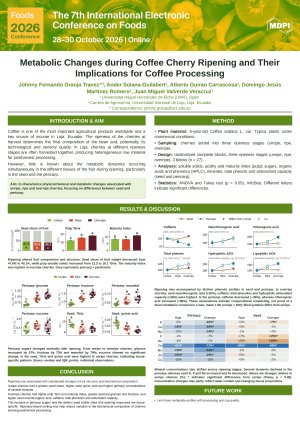
The biochemical composition of coffee cherries at harvest strongly influences the quality of the raw material entering postharvest processing. However, in many coffee-producing regions, including Loja (Ecuador), pre-ripe, ripe, and over-ripe cherries are commonly harvested together without selective sorting, resulting in heterogeneous material for fermentation, drying, roasting, and beverage production. This study evaluated the physicochemical and metabolic changes occurring in the pulp, pericarp, and seed of Coffea arabica L. var. Typica across three ripening stages to investigate their potential implications for coffee processing.
Ripening induced a marked metabolic reorganization between fruit tissues. In the pulp and pericarp, total soluble solids, glucose, and fructose increased progressively, indicating a greater availability of fermentable carbohydrates during the initial stages of processing. Conversely, the seed followed a different metabolic trajectory, characterized by decreasing glucose and quinic acid concentrations together with increasing neochlorogenic acid, caffeine, total phenolics, and antioxidant activity. These changes suggest a progressive transition from primary to secondary metabolism as ripening advances. In addition, potassium, calcium, and iron decreased significantly in the pericarp, indicating coordinated physiological changes accompanying fruit maturation.
Collectively, these metabolic shifts modify the biochemical composition of the cherries entering postharvest processing. The differential distribution of carbohydrates, organic acids, minerals, and bioactive compounds among ripening stages is expected to influence the availability of fermentation substrates and the pool of chemical precursors involved in subsequent roasting reactions. Consequently, processing cherries with heterogeneous ripening stages may contribute to greater variability in the chemical composition of the processed beans and, ultimately, in coffee quality. These findings highlight the importance of selective harvesting or ripeness-based sorting as practical strategies to improve the biochemical uniformity of the raw material and enhance the consistency of coffee processing and final beverage quality.
Keywords
coffee ripening
postharvest processing
metabolic profiling
bioactive compounds
fermentation substrates
roasting precursors.
Poster
Poster_FOODS2026_version final JG.pdf
Safety-by-Design of Functional Camel Milk Kefir Using Predictive Microbiology and Machine Learning for Salmonella Control
Influence of Processing Operations on the Functional and Rheological Properties of Legume Flours